
In our volatile professional landscape, the old adage "leaders are born, not made" has been thoroughly debunked. Today, leadership is less about a corner office and more about a specific, refined set of competencies.
Leadership training is the single best investment for both career growth and organizational success. It is crucial for mid-level managers aspiring to the C-suite, as well as for HR professionals responsible for future-proofing their company's workforce. Below, I'll share with you not only why you should absolutely do leadership training, but also how to go about selecting a program that will have the greatest impact on your career path.
What is leadership training?
At its core, leadership training is the structured development of skills required to inspire, influence, and guide individuals toward a collective goal. While many mistake it for simple "management training," the two are distinct.
Management is about systems; leadership is about people. Modern leadership training moves beyond the classroom into real-world applications of strategic thinking, conflict resolution, and vision-casting. It is a continuous process of unlearning authoritative habits and adopting a "servant leadership" mindset.
Management is about systems; leadership is about people.
Management vs. leadership: A modern comparison
To understand why specialized training is necessary, we must look at how the role has evolved.
| Feature | Traditional management | Modern leadership |
|---|---|---|
| Focus | Task execution and processes | People, vision, and inspiration |
| Authority | Derived from job title/rank | Derived from trust and influence |
| Objective | Maintaining the status quo | Driving innovation and growth |
| Approach | Directs and controls | Empowers and coaches |
| Communication | Top-down instructions | Active listening and feedback loops |
| Risk Profile | Risk-averse; follows the manual | Calculated risk-taking; adaptive |
The 4 pillars of modern leadership development
There are thousands of data points to identify the competencies that actually move the needle in high-growth environments. Effective leadership development programs must focus on these four pillars:
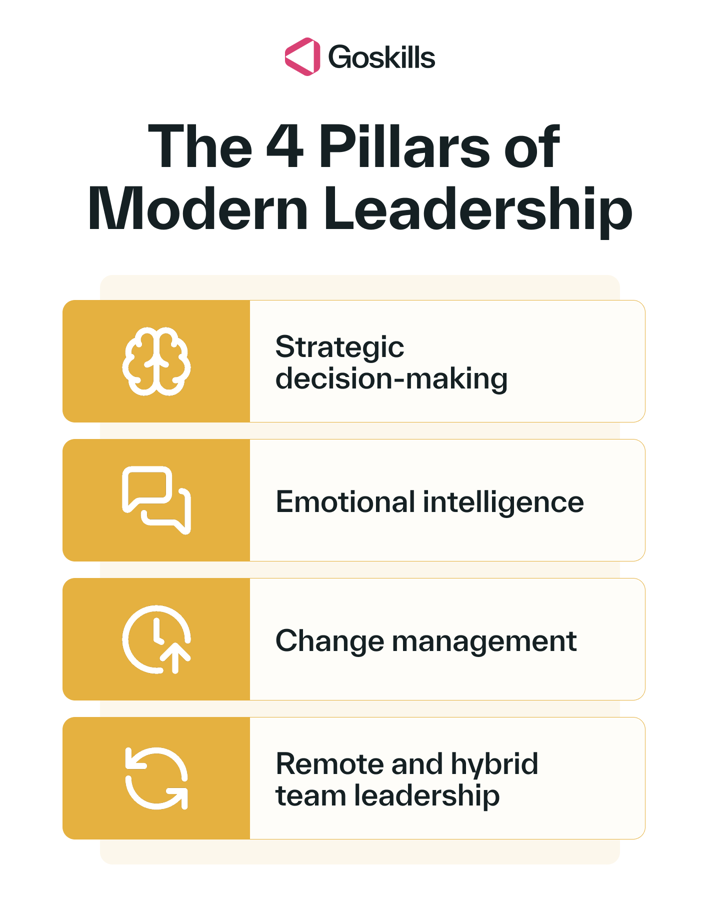
1. Strategic decision-making
The shift from a "doer" to a "leader" requires moving from tactical execution to long-term vision. Training helps managers stop putting out daily fires and start building fireproof systems. It involves learning how to weigh ROI against opportunity costs and making hard calls even when data is incomplete.
2. Emotional intelligence (EQ)
In 2026, EQ is the ultimate "hard skill." It is the ability to recognize your own emotional triggers and navigate the complex interpersonal dynamics of your team. Leaders with high EQ foster psychological safety, which is the #1 predictor of high-performing teams.
Free lesson on emotional intelligence in leadership by Dan Gorgone
3. Change management
The tech landscape changes weekly. Whether it’s integrating new AI workflows or pivoting business models, leaders must be the "shock absorbers" for their teams. Leadership training provides the framework to lead through volatility without burning out your staff.
4. Remote & hybrid team mastery
The "new normal" is now just "normal." Leading a team across three time zones requires a different toolkit than leading a team in one room. This includes mastering asynchronous communication, digital empathy, and outcome-based performance tracking rather than "hours-in-seat" monitoring.
The business case: Why companies need leadership training
If you’ve already been given some management responsibilities, you shouldn't view leadership training as a "nice-to-have" perk. It is a survival strategy.
- Retention: The data remains consistent: people don’t quit jobs; they quit bad managers. Investing in soft skills is an organization's most effective way to lower turnover costs.
- Productivity: Skilled leaders remove bottlenecks. They know how to delegate effectively, ensuring that the right people are working on the right tasks, which directly impacts the bottom line.
- Corporate ethos: By the time someone gets to the level of Director or VP, it’s often too late to start training them. Poor management styles have likely already begun to take root, and company culture has been formed around an unequipped “leader”.
How to choose the right leadership training program
Not all programs are created equal. To ensure your time and money aren't wasted, use this checklist when evaluating options:
- [ ] Is it self-paced? Modern leaders are busy. Look for "micro-learning" formats that allow you to learn in 10-15 minute bursts.
- [ ] Is it practical? Avoid theory-heavy academic courses. You want actionable frameworks you can use in your 1-on-1s tomorrow.
- [ ] Is it accredited? Ensure the provider offers recognized certifications or CEUs (Continuing Education Units) to validate your growth.
- [ ] Does it offer executive coaching? Sometimes, you need a sounding board. Look for programs that offer access to experts or peer communities.
Check it out: Try GoSkills’ flagship online leadership course by the award-winning David Brownlee.
Leadership training examples you can start today
You don't need a formal title to start practicing leadership. Here are four"mini-lessons" you can implement immediately:
1. Effective coaching
This free lesson by David Brownlee in GoSkills’ Leadership Training course emphasizes that modern leadership is rooted in reinforcing your team’s capabilities by identifying and capitalizing on individual strengths to build a cohesive, high-performing unit. Active coaching, through verbal or written acknowledgment, boosts team self-esteem and creates a safe environment in which calculated failure is accepted as a necessary step toward innovation and organizational growth.
Free lesson on effective coaching by David Brownlee (Leadership Training)
2. The Radical Candor framework
Kim Scott’s "Radical Candor" is a staple in modern training. It’s the ability to challenge directly while caring personally. Next time you give feedback, ask yourself: "Am I being clear enough to help them improve, and do they know I'm saying this because I want them to succeed?"
Kim Scott's principle of "radical candor"
3. High-impact 1-on-1s
Stop using 1-on-1s for status updates (those should be in Slack or email). Use this time for career development and removing roadblocks. Ask: "What is the one thing blocking your progress this week that I can remove for you?"
4. The 70/20/10 rule of delegation
Training yourself to delegate is the hardest part of leadership.
- 70%: If someone can do the task 70% as well as you, delegate it.
- 20%: Use this as a coaching opportunity to get them to 90%.
- 10%: Reserve only the most critical, high-stakes tasks for yourself.
FAQs about leadership training
What are the 3 main types of leadership training?
Typically, these include Executive Coaching (one-on-one high-level guidance), Management Essentials (foundational skills for new managers), and Strategic Leadership (focusing on organizational change and vision).
Is leadership training worth it for small teams?
Yes. In fact, it's often more critical. In small teams, one bad manager has a much higher impact on the company culture and bottom line than in a massive corporation.
How long does it take to see results from management coaching?
While technical skills can be learned in days, leadership is a "behavioral" skill. You will likely see immediate improvements in communication within weeks, but full cultural shifts typically take 3 to 6 months of consistent practice.
Take charge of your trajectory
The most successful leaders of the next decade won't be those with the most "authority". They will be the ones who invested in their ability to adapt, empathize, and strategize.
Don't wait for a promotion to start leading. Access our full suite of leadership and management courses today.
Become a better leader
Start learning for free with Leadership & Management courses on GoSkills
Learn more