
In the modern workplace, your technical expertise — your ability to code, crunch numbers, or design a marketing funnel — is your ticket to the interview. But it’s your soft skills that actually land you the job and propel you into leadership.
The professional landscape has shifted. With AI managing data-heavy tasks and automation streamlining workflows, the "human advantage" has become the ultimate currency. Employers are no longer just looking for what you can do; they are looking for how you think, connect, and adapt.
In this guide, I’ll share some soft skills examples and give you a breakdown of the essential ones you need to future-proof your career. This will give you a roadmap to turn these intangible traits into measurable career growth.
What are soft skills? The definition
At their core, soft skills are the non-technical traits and behaviors that dictate how you work and interact with others. While "hard skills" are the specific, teachable abilities required to perform a job (like proficiency in Excel or Java), soft skills are the "people skills" or "emotional intelligence" (EQ) that make you an effective colleague.
The main difference? Hard skills are often job-specific, whereas soft skills are transferable. Whether you are a surgeon or a software engineer, the ability to communicate clearly and solve problems under pressure remains equally vital.
Deep Dive:
Want to see how these two skill sets balance each other out?
Check out our guide on hard skills vs. soft skills.
Why soft skills matter more than ever
We’ve officially entered the era of "the human advantage." According to recent LinkedIn Global Talent Trends, soft skills now rank as the most important factor in hiring, with 92% of talent professionals stating they matter as much as, or more than, hard skills. Besides this statistic, the study emphasizes that 89% of talent professionals say bad hires often lack these soft skills.
The AI factor
As generative AI becomes a standard office tool, the value of technical execution has depreciated. Why? Because an LLM can write a basic report, but it cannot empathize with a frustrated client, navigate office politics, or inspire a team during a pivot.
Remote & hybrid realities
In a world of Zoom calls and Slack threads, the margin for error in communication is slim. Soft skills like active listening and digital etiquette are now the glue holding remote teams together. If you want to move into management, these "soft" attributes are the primary criteria for leadership roles.
Related: Why employers will value soft skills over tech in the age of AI
Top soft skills examples by category
To help you audit your own toolkit, I’ve categorized the most in-demand soft skills for the modern workplace.
Communication skills: The foundation of influence
Communication isn't just about talking; it's about the effective exchange of ideas.
1. Active listening: Giving your full attention to the speaker, understanding their message, and responding thoughtfully.
2. Non-verbal communication: Understanding body language, tone of voice, and even "digital tone" in emails.
3. Public speaking: The ability to present ideas clearly and persuasively to a group, whether in person or via video conference.
4. Constructive feedback: Both giving and receiving critique in a way that fosters growth rather than defensiveness.
Interpersonal skills: Building the "human advantage"
These skills determine how well you play in the sandbox with others.
5. Empathy: The ability to understand and share the feelings of another. This is the #1 skill for modern managers.
6. Conflict resolution: Navigating disagreements professionally and finding "win-win" solutions.
7. Teamwork: Collaborating across departments to achieve a common goal.
8. Cultural intelligence: Respecting and working effectively with people from diverse backgrounds and perspectives.
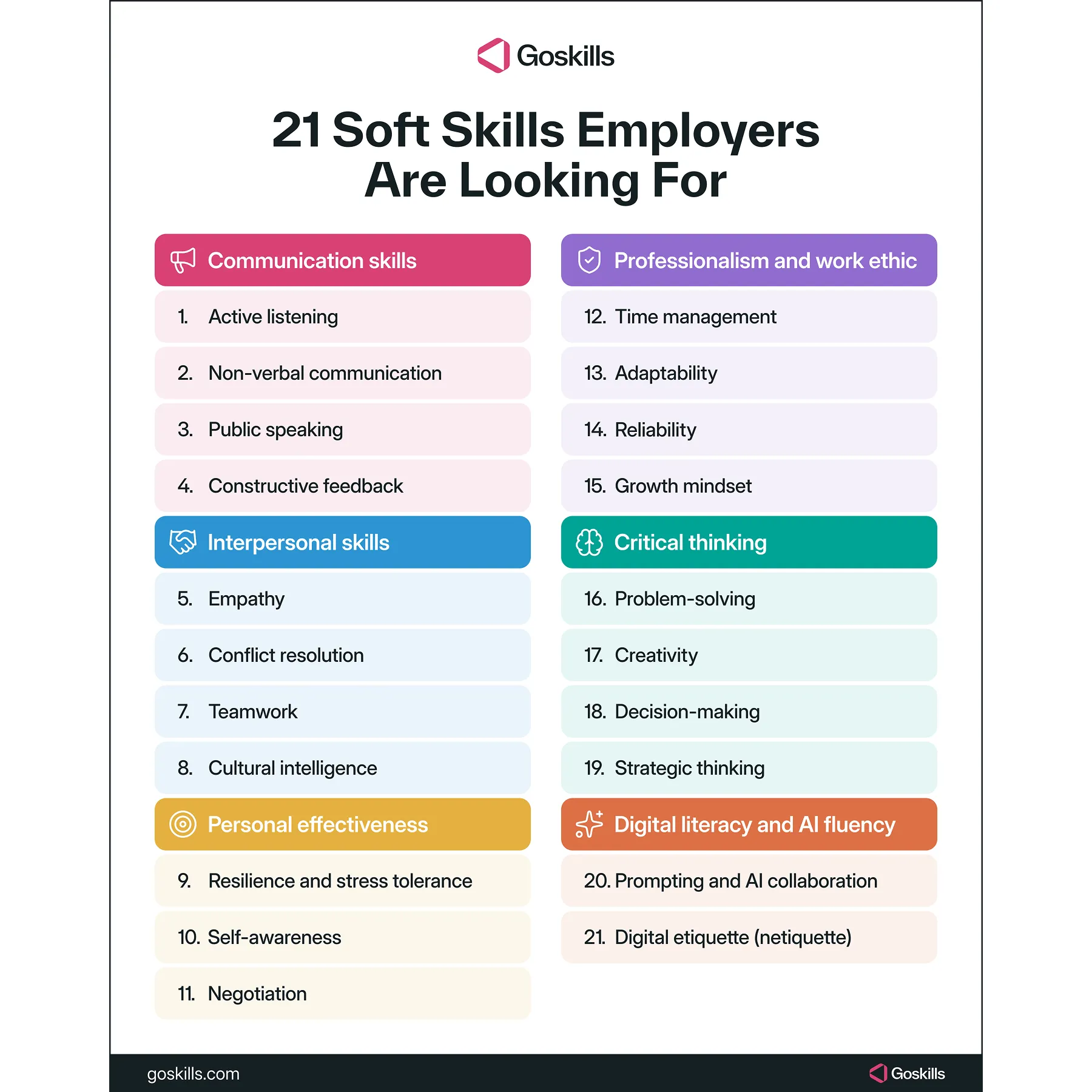
Professionalism & work ethic: The reliability factor
This is about how you manage yourself.
9. Time management: Prioritizing tasks effectively in a world of constant distractions.
10. Adaptability: Staying productive and positive when plans change (which they will).
11. Reliability: Being the person who does what they say they’re going to do, every time.
12. Growth mindset: A willingness to learn, unlearn, and relearn as industry standards evolve.
Critical thinking: The problem-solving engine
Employers want people who can think their way out of a paper bag without a manual.
13. Problem-solving: Identifying the root cause of an issue and implementing a logical solution.
14. Creativity: Thinking "outside the box" to find innovative approaches to old problems.
15. Decision making: Evaluating data and intuition to make a call, even when information is incomplete.
16. Strategic thinking: Understanding how your daily tasks contribute to the company’s long-term goals.
Personal effectiveness: Maximizing your competencies
These are the internal skills that keep you steady when the workplace gets chaotic.
17. Resilience & stress tolerance: The capacity to recover quickly from difficulties and maintain a functional level of performance under high-pressure situations.
18. Self-awareness: Recognizing your own emotions, triggers, and biases. This is the bedrock of emotional intelligence (EQ); you can't manage others effectively until you can manage yourself.
19. Negotiation: Beyond just salary discussions, this is the daily skill of persuading others to support your ideas, managing resource allocation, and reaching agreements that satisfy multiple stakeholders.
Digital literacy & AI fluency: The “soft” side of hard skills
Today, "soft" skills include how you interact with technology to augment your human capabilities. These skills combine technical competence with critical thinking, adaptability, and problem-solving to navigate, evaluate, and create information.
20. Prompt engineering & AI collaboration: The ability to effectively communicate with AI tools to generate high-quality outputs. It’s less about coding and more about linguistic precision and logic.
21. Digital etiquette (Netiquette): Understanding the nuances of professional behavior in virtual spaces — knowing when a meeting should have been an email, or how to maintain presence in a hybrid "camera-on" culture.
How to highlight soft skills on your resume
The biggest mistake job seekers make is simply listing "Great communicator" in a bulleted list. To an interviewer, that means nothing. Your aim is to show, not just tell.
Instead of using vague adjectives, use action-oriented results to prove your soft skills.
|
Instead of saying... |
Try saying... |
|---|---|
|
"Good at communication" |
"Managed a remote team of 12 to deliver a product launch 15% ahead of schedule via streamlined Slack workflows." |
|
"Problem solver" |
"Identified a recurring bottleneck in the supply chain and implemented a new tracking system that reduced delays by 20%." |
|
"Adaptable" |
"Successfully pivoted marketing strategy mid-campaign in response to market shifts, resulting in a 10% increase in ROI." |
|
"Team player" |
"Collaborated cross-functionally with Engineering and Sales to resolve 50+ client pain points in Q3." |
Replace cliché phrases on your résumé with meaningful, results-oriented ones.
How to develop your soft skills
There is a common myth that you are either "born with" soft skills or you aren't. This couldn't be further from the truth. Soft skills are muscles — they require intentional practice, feedback, and training to grow.
1. Identify your gaps
Ask for a 360-degree review from peers or mentors. Are you great at the technical side but struggle to present your findings? That’s a signal to work on your presentation skills.
2. Practice "micro-habits"
If you want to improve active listening, make it a goal to not interrupt anyone for an entire day. If you want to improve time management, try the Pomodoro technique for a week.
3. Take targeted courses
You don't have to figure it out by trial and error. The GoSkills library is specifically designed to help you master these "human" elements.
- Leadership & management: Learn how to lead with empathy and strategy. Explore leadership courses.
- Communication mastery: From body language to business writing.
- Productivity tools: Master the art of getting things done without the burnout.
Ready to level up? Browse our Soft Skills course library and start building the traits that make you irreplaceable.
Frequently asked questions (FAQs)
-
Can soft skills be learned?
Absolutely. While some people may have a natural inclination toward certain traits, soft skills are behaviors that can be refined through cognitive behavioral shifts and consistent practice.
-
What are the 5 most important soft skills for work?
While it varies by industry, the five most universally sought-after skills are:
- Adaptability (managing change)
- Communication (clarity across mediums)
- Critical thinking (problem-solving with AI)
- Emotional intelligence (empathy and self-awareness)
- Time management (autonomy in remote work)
-
How do I mention soft skills in an interview?
Use the STAR method (Situation, Task, Action, Result). When asked a question like "Tell me about a time you handled a difficult client," focus on the soft skill you used (e.g., empathy or conflict resolution) to reach a positive result.
Final thoughts: The future is human
As technology continues to advance, the "soft" stuff is becoming the "hard" stuff. Being technically proficient is no longer enough to guarantee career longevity. By investing in your ability to communicate, lead, and think critically, you aren't just improving your resume — you're future-proofing your life.
Ready to get started? Learn with GoSkills and master the skills that get you hired.