Using Python With Excel
Using Python With Excel
What you’ll learn
Skills you’ll gain
Excel can be a blessing and a curse. Working with small amounts of data and simple operations? Excel is your go-to tool. However, Excel’s limitations show themselves whenever you need to work with large amounts of data and perform the types of complex operations necessary to compile key analytics. Enter Python, rapidly becoming one of the world’s most popular programming languages. As a powerful tool that can speed up your data operations, Python --- in conjunction with Excel --- lets you inspect, clean, and filter data, along with the ability to create memorable and dynamic reports that deliver crucial business insights. Whether it’s converting data, creating visually striking graphs and charts, or shaping large amounts of data in any number of useful ways, you'll find a new-found ease and efficiency with Python that would be otherwise unattainable in Excel alone.
Syllabus
Download syllabus-
1
Jupyter Notebooks basics If you don't think code can be beautiful, you have to check out Jupyter Notebooks. 2m
-
2
Introducing the Python pandas library Pandas is a Python library that provides powerful data analysis features. 1m
-
3
Loading and saving data with pandas When working with Excel in Python, you have to deal with large amounts of data. 3m
-
4
Viewing and inspecting data with pandas When working with pandas, manipulating the dataFrame is key to getting what you want out of the data. 2m
-
5
Manipulating data with pandas As you manage datasets you'll need more methods to organize, compare, and sort our data. 3m
-
6
Working with dates and times in pandas The name "pandas" isn't just for cute animals... 4m
-
1
Using openpyxl with workbooks Workbooks are a core component to navigating data in Excel. 3m
-
2
Selecting cells, rows, and columns When working within an Excel document, accessing your values and navigating through the spreadsheet is one of the most used and basic tools. 3m
-
3
Adding workbook formatting When presenting large sets of data to others, it is important to format it in such a way that's readable and understandable. 3m
-
4
Creating named ranges and tables Just like Python, Excel works best when its data components are named properly. 4m
-
1
Managing multiple sheets Managing multiple sheets is a common occurence in Excel. 4m
-
2
Working with large worksheets Openpyxl is slow when working with extremely large datasets. 4m
-
3
Conditional formatting Excel reports often include conditional formatting which conveniently add visual cues to data tables. 4m
-
4
Creating Excel plots in Python Excel charts are familiar to almost every spreadsheet user. After watching this video, you'll be able to create dynamic Excel charts using openpyxl. 4m
-
5
Exporting Python plots to Excel Some charts are difficult or perhaps impossible to create in Excel. 3m
-
1
Next steps Thank you for watching this course! 1m
Certificate
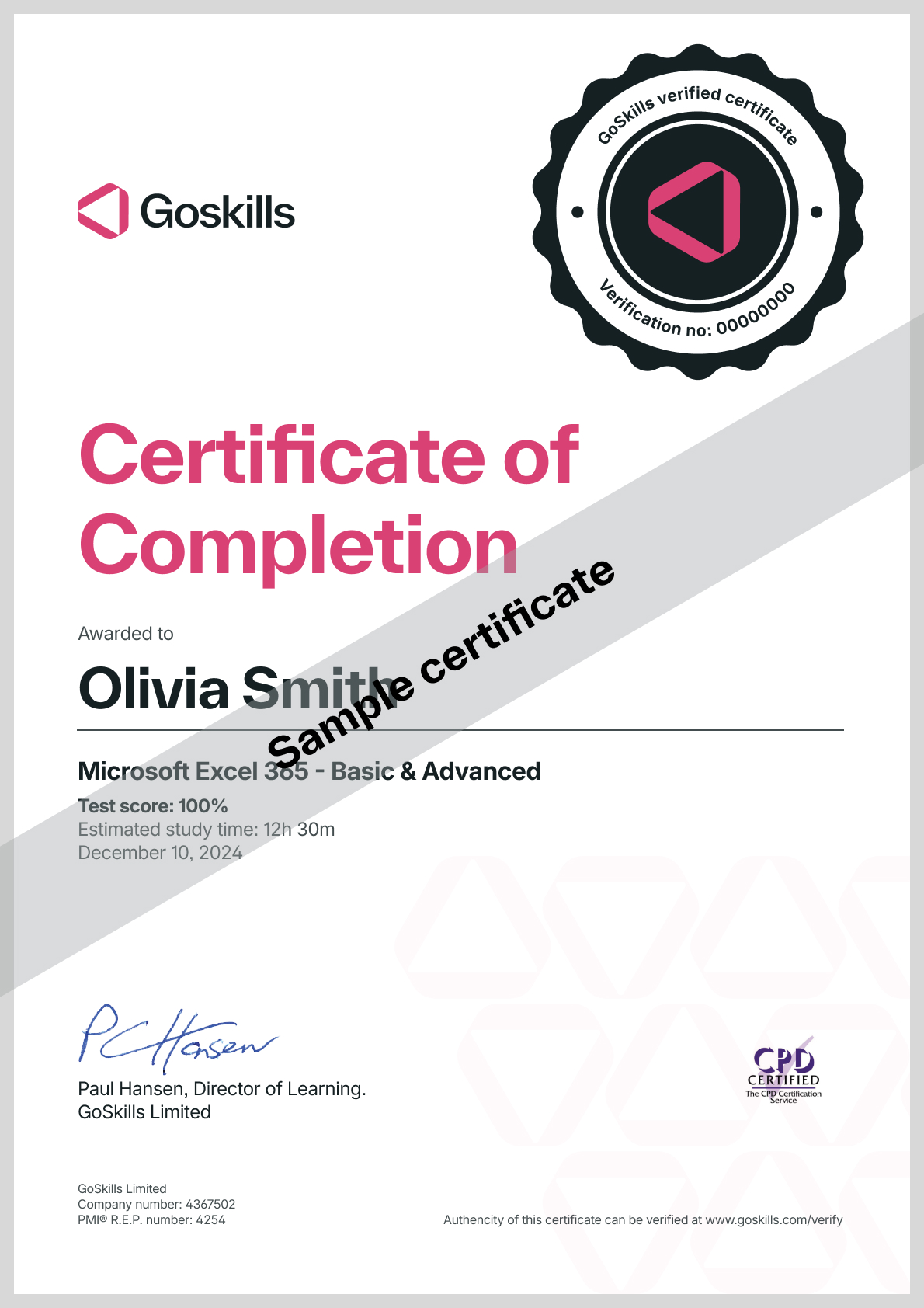
Certificate of Completion
Awarded upon successful completion of the course.
Instructor
George Mount
George Mount is the founder and CEO of Stringfest Analytics, a consulting firm specializing in analytics education and upskilling. He has led bootcamps, and worked with learning platforms and practice organizations to help individuals shine at analytics. George regularly blogs and speaks on data analysis, data education, and workforce development. He holds a bachelor’s degree in economics from Hillsdale College and a Master’s Degree in Finance and Information Systems from Case Western Reserve University.

George Mount
Data Analytics Author and Expert
Accreditations
Link to awards
How GoSkills helped Chris
I got the promotion largely because of the skills I could develop, thanks to the GoSkills courses I took. I set aside at least 30 minutes daily to invest in myself and my professional growth. Seeing how much this has helped me become a more efficient employee is a big motivation.