SQL Fundamentals
SQL Fundamentals
What you’ll learn
Skills you’ll gain
Structured Query Language, or SQL, is the industry standard language to manage data within a database. Because of this, being able to use it can unlock tons of opportunity in your career! In this course, data analyst and content creator Shashank Kalanithi will empower you with the foundational skills to get started using SQL. Shashank will first review baseline information of how SQL is set up, how it works with databases, and what a SQL environment is. He then guides you through running a SQL query to filter, catalog, and clean your data. He shares advanced querying types, such as grouping or aggregating data, as well as combining data within your SQL environment. He also reviews some skills to leverage as you get comfortable with SQL, such as intermediate filtering and advanced aggregation capabilities. After this course, you'll be ready to start using SQL in your role.
Syllabus
Download syllabus-
1
What is SQL? What is SQL and why should you care? 1m
-
2
Setting up SQL There are many ways you can interact with a SQL database. After watching this video, you'll be able to perform your own environment setups. 1m
-
3
Interpreting databases Databases are a core way businesses store their data. 1m
-
4
SQL environment structure Like many things on a computer, SQL Environments follow a logical hierarchy of objects. 2m
-
1
Running a query SQL queries are the fundamental way you can pull data from SQL databases. 3m
-
2
SQL data types Data types are a core part of SQL and help you structure your data cleanly and securely. 1m
-
3
Filtering data You'll rarely want to pull all of the data from a table. 3m
-
4
NULL data NULL values are a common occurrence in database records. 1m
-
5
Outputting clean data When presenting results, you'll often need to organize your work prior to the presentation. 2m
-
1
Grouping data Grouping your data allows you to generalize information from many rows down to just one row. 1m
-
2
Aggregating data Along with being able to group your data, you'll also want to add, count, or average out the numerical columns. 2m
-
3
CASE statements Depending on the conditions, you may want your columns to dynamically change. 1m
-
4
Using subqueries SQL queries can get quite long and complex, subqueries offer an easy way to organize SQL queries one after another. 3m
-
1
Adding columns together Oftentimes, the column of data you need might not be readily available, so you'll need to combine the data of multiple columns into one. 1m
-
2
Combining with unions Necessary data can live in multiple different tables, and in these cases, you can combine tables through a UNION operation. 1m
-
3
Combining horizontal data If you need to combine data horizontally, then you'll use a join function. 3m
-
4
Join gotchas Joins are very powerful, but using them can easily lead to data errors if you aren't careful. 3m
-
1
Wildcard operators If you want to do more than simple filtering, then you'll need to use wildcard operators. 1m
-
2
Filtering using lists You may only want to select certain values in a range, and in these situations you'll use the BETWEEN and IN operators. 1m
-
1
Understanding window functions While you'll usually manipulate data on a column basis, there may be instances where you'll want to manipulate based on the row. 1m
-
2
Structuring window functions When using a window function, there are several factors you'll need to account for when crafting your framework. 1m
-
3
Referencing different rows LAG, LEAD, and OFFSET are the most commonly used additions to a basic window function. 1m
-
4
Ranking your data If you want to order data by certain groups in the same row, you can use the RANK operator. 1m
-
1
SQL order of execution One important factor with SQL is that SQL operators are not executed in the order they're written in. 1m
-
2
SQL is non-standard What you consider to be SQL is effectively a loose set of standards that change depending on what RDBMS you use. 2m
-
1
Let's get started Thanks for watching this course! 1m
Certificate
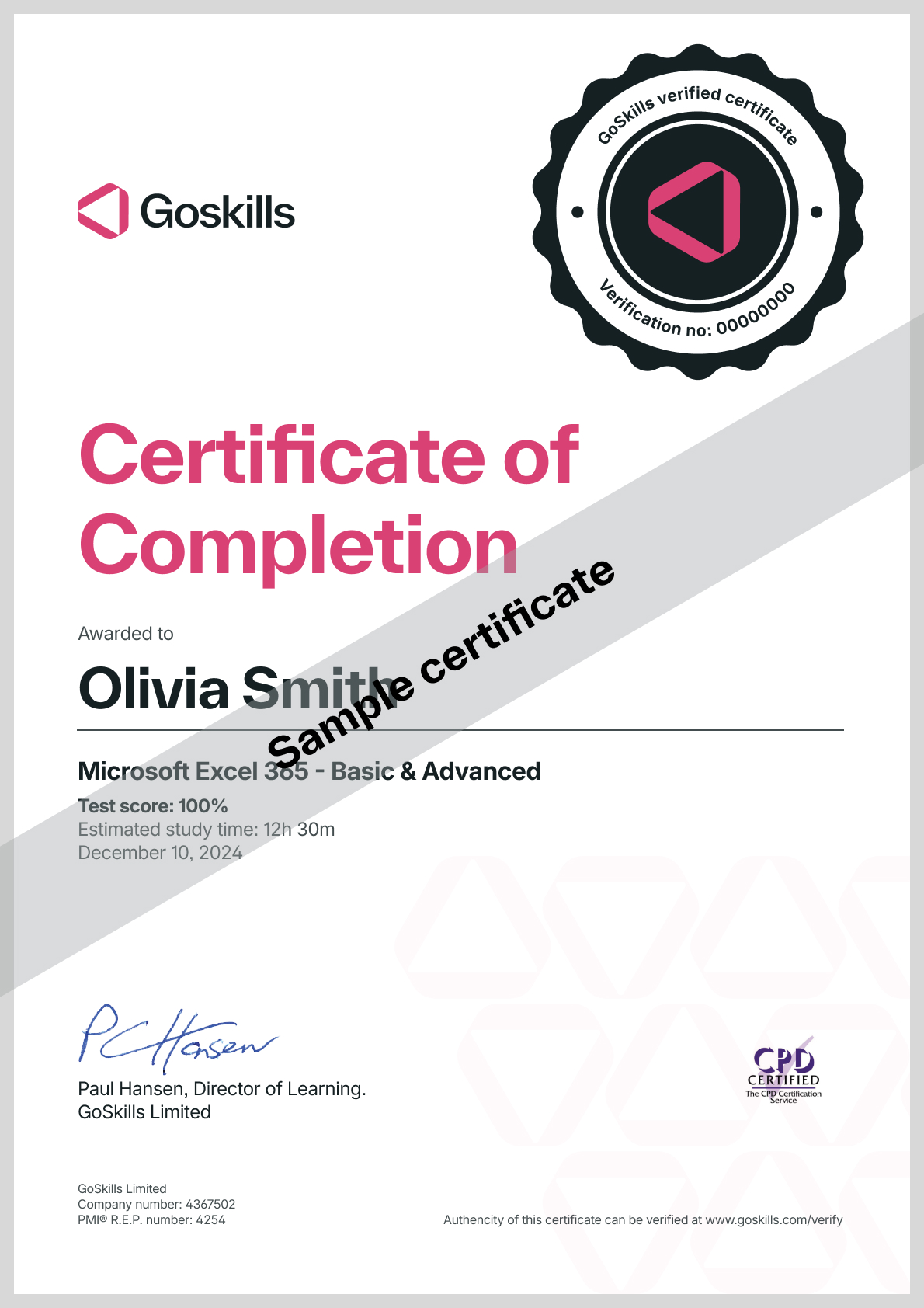
Certificate of Completion
Awarded upon successful completion of the course.
Instructor
Shashank Kalanithi
Shashank Kalanithi is a practicing Senior Data Analyst with a passion for helping others enter the world of Analytics. He has helped numerous clients with their analytical needs through his independent consulting practice and has worked at companies ranging from Interstate Batteries to Nordstrom. He has a Bachelor's from Emory University in Chemistry and sees it as proof that anyone can enter the world of analytics regardless of education.

Shashank Kalanithi
Data Analyst at Nordstrom
Accreditations
Link to awards
How GoSkills helped Chris
I got the promotion largely because of the skills I could develop, thanks to the GoSkills courses I took. I set aside at least 30 minutes daily to invest in myself and my professional growth. Seeing how much this has helped me become a more efficient employee is a big motivation.