
In the modern corporate landscape, the distinction between a “boss” and a true leader has never been more critical.
Many organizations fall into the trap of treating leadership as a destination — a title earned through tenure — rather than a continuous mindset that must be nurtured at every level.
To remain competitive, companies must shift from sporadic interventions to a structured leadership development training model that builds a sustainable, future-proof pipeline.
This is the “compound effect of leadership” in action: small, daily improvements in management capability, scaled across an organization, can lead to significant shifts in performance and culture. For HR directors and C-suite executives, the goal is to transform high-potential employees (HiPos) into high-performing leaders who can navigate complex business challenges with confidence.
What is leadership development training?
Leadership development training is the structured, ongoing process of building leadership skills across an organization — not just in senior leaders, but in leaders at all levels. Unlike one-off leadership training sessions, leadership development focuses on long-term growth, helping individuals develop a leadership mindset, communication skills, and decision-making capabilities over time.
Before mastering executive strategy, leaders must first perfect their foundational soft skills training. These include emotional intelligence, adaptability, and the ability to influence others — all critical to effective leadership.
Organizations that invest in leadership development consistently outperform those that rely on sporadic training courses. Why? Because leadership is not an event — it’s a learning journey.
Leadership training vs. Leadership development: What’s the difference?
One of the most common mistakes in talent development is treating leadership training and leadership development as interchangeable. While closely related, the distinction is critical.
- Leadership training is typically focused on a specific skill and delivered as a one-time event, such as a workshop, seminar, or in-person session. A manager might attend a session on conflict resolution, feedback, or delegation and leave with useful ideas. However, when too much information is delivered at once, it can be difficult to absorb, apply, and sustain. In some cases, traditional leadership training programs can even contribute to leadership burnout by overwhelming participants rather than supporting steady growth.
- Leadership development, on the other hand, is a process — a continuous learning journey that focuses on long-term growth and the evolution of a leadership mindset. It combines learning, practice, reflection, feedback, and real-world application to help leaders strengthen their skills gradually and consistently.
That distinction is especially important for organizations looking to build a long-term leadership pipeline, because the conversation around leadership vs. management often shapes how future leaders are developed.
Benefits of leadership development training
Developing leaders is not an exercise that is reserved for large corporate entities. If it is important in large corporations, it is absolutely imperative for smaller teams, for the following reasons:
1. Developing potential leaders lowers the risk of the Peter Principle
In a corporate setting, developing leaders matters because it prevents the problem of “accidental leaders” – employees who are good individual contributors but who are not necessarily equipped to lead. Without structured development, companies end up with managers who are guessing at things like giving feedback, running meetings, or handling conflict — skills that don't come automatically with a title.
2. It builds a leadership pipeline instead of a leadership gap
Another benefit of corporate leadership development training is that organizations that are constantly developing the next set of leaders will always have internal people ready to step up. Doing so means they can confidently promote from within rather than invest in an expensive, sometimes risky external search.
3. It protects against costly turnover
Good leaders can also be the difference between a high turnover rate and the retention of qualified, high-performance employees. It is often said that employees don't quit companies as often as they quit bad managers. Weak leadership at the team level shows up directly in disengagement and attrition, and the cost of replacing an employee (recruiting, onboarding, lost productivity) is expensive. Investing in leaders is often cheaper than the cost of losing people under them.
How to build a leadership development program
There are 5 steps to creating an effective leadership development program.
- Identifying high-potential employees (HiPos)
- Building core competencies into your program
- Structuring a learning path (15 courses across 3 levels)
- Scaling and managing it with an LMS
- Measuring program success
Step 1: Identify high-potential employees (HiPos)
Not all employees follow the same leadership path. Identifying high-potential individuals early allows organizations to invest in personalized development.
Use employee performance review sessions to identify leadership potential based on:
- Work output
- Learning agility
- Communication skills
- Problem-solving ability
HiPos often demonstrate initiative, resilience, and the ability to influence others — even without formal authority. Once identified, these employees can enter a structured leadership program tailored to their growth stage.
Step 2: Build core competencies into your program
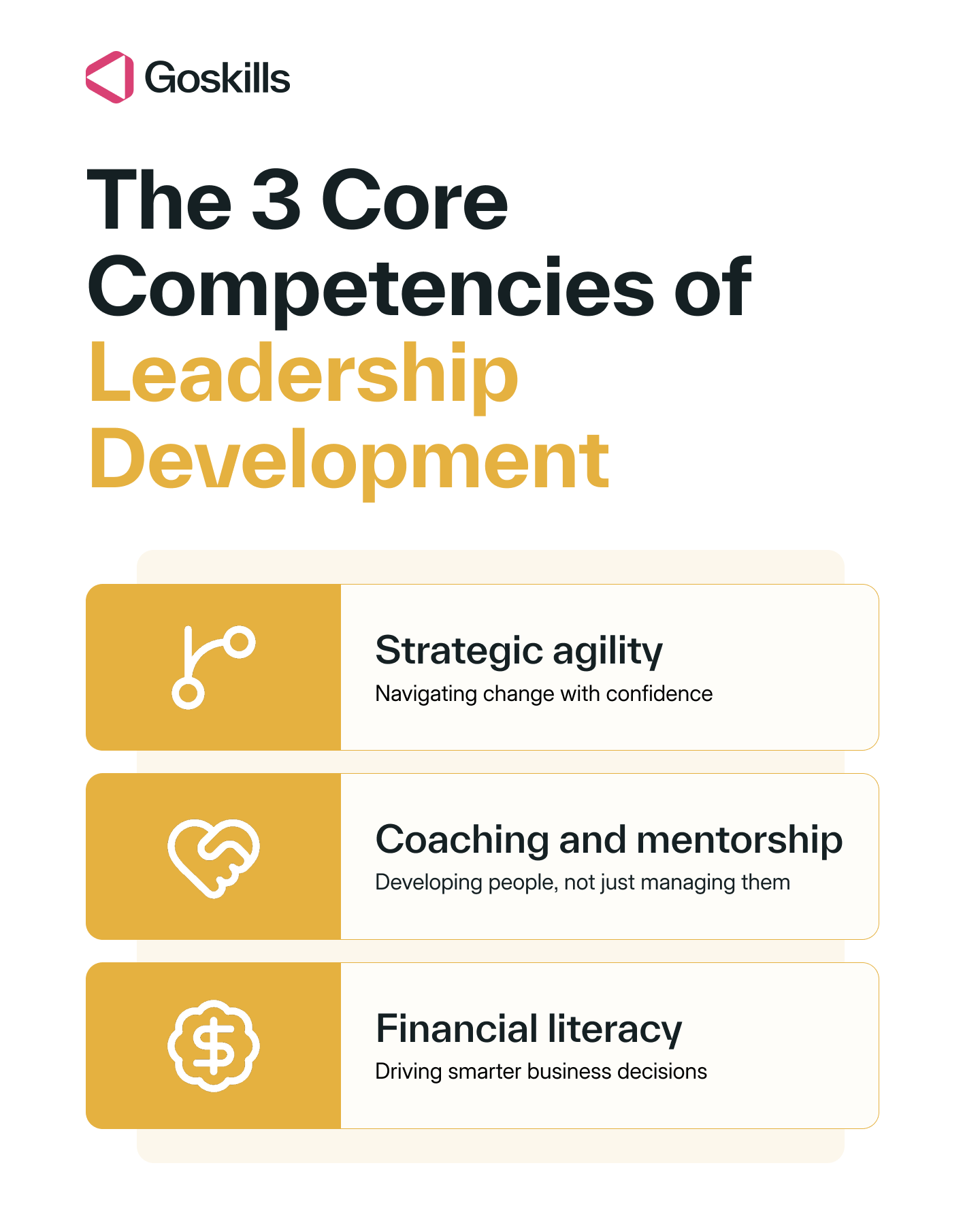
A comprehensive leadership development program should focus on building the core competencies individuals need to take on greater responsibility over time. The best leadership development training programs typically include education in the following areas:
- Strategic agility: the ability to anticipate change, respond, adapt, and keep teams aligned through uncertainty.
- Coaching and mentorship: supporting, developing, and helping others grow.
- Financial literacy: having a working understanding of budgeting, forecasting, and financial metrics.
Step 3: Structure a learning path: 15 courses across 3 levels
With GoSkills, organizations can build a scalable, personalized development program using microlearning, on-demand content, and tailored learning paths. The result is a flexible learning journey that helps leaders grow consistently without pulling them away from their day-to-day responsibilities.
Here are a few example paths organizations can use to structure a leadership development program with the Leadership & Management courses in the GoSkills library:
Level 1: Self-leadership
At this stage, the focus is on building personal effectiveness, accountability, and foundational leadership habits.
Recommended learning path:
- Time Management for Leaders
- Essential Productivity Training
- Emotional Intelligence
- Goal Setting for Personal and Professional Success
- Communication Skills Basics
These courses help individuals develop the self-awareness and discipline needed to lead themselves before leading others — a critical first step in any leadership development program.
Level 2: Team leadership
As employees transition into leadership roles, the focus shifts to managing people, building trust, and developing communication skills.
Recommended learning path:
- Team Leadership
- Coaching Skills for Leaders
- Conflict Resolution for Professionals
- Leading Effective Meetings
- Motivate Your Team
This stage equips new leaders with the skills needed to manage direct reports, navigate team dynamics, and create a positive, high-performing team environment.
Level 3: Operational leadership
At this level, leaders are responsible for driving performance, managing resources, and aligning team efforts with organizational goals.
Recommended learning path:
- Project Management Basics
- Finance for Non-Financial Professionals
- Leading Through Change
- Performance Improvement Plans: A Leader’s Guide to Turning Things Around
- Data-Backed Decision Making
These courses help leaders connect strategy with execution — enabling them to make informed decisions, manage complexity, and drive business results.
Explore the collection of bite-sized Leadership & Management courses on GoSkills
Step 4: Scale and manage it with an LMS
With the GoSkills LMS, organizations can turn these learning paths into fully operational leadership development programs by assigning training, tracking progress, and continuously improving outcomes from a single platform.
Here’s how GoSkills helps organizations scale leadership development:
- Create and assign structured learning paths at scale: Easily assign curated leadership development training programs to individuals, teams, or departments based on role, seniority, or goals.
- Deliver flexible learning with microlearning and live online options: Combine on-demand, bite-sized lessons with live online training to support different learning styles without disrupting daily work.
- Track learner, course, and team performance in real time: Use built-in reporting and analytics to monitor progress, identify skill gaps, and measure the impact of your leadership development program.
- Customize training with your own content: Use the GoSkills course builder and AI assistant, Genie, to create tailored training that aligns with your organization’s specific business challenges and leadership competencies.
- Support personalized development at every level: Adapt learning paths based on individual progress, ensuring leaders at all levels receive the right training at the right time.
- Validate learning with certificates and assessments: Reinforce accountability and track achievement with built-in assessments and certificates that support professional development.
This blended approach — combining structure, flexibility, and data — enables organizations to develop leaders continuously, build a high-performing culture, and maintain a strong leadership pipeline over time.
Step 5: Measure program success
To understand whether your leadership development efforts are working, track clear performance indicators that reflect both learner progress and organizational impact.
Common metrics include:
- Internal promotion rates
- Employee engagement scores
- Time to productivity for new leaders
- Retention rates among high-potential employees
Together, these metrics can help organizations identify what is working, refine their development strategy, and demonstrate the ROI of leadership training programs over time.
Frequently asked questions about leadership development training
1. What is leadership development training?
Leadership development training is the ongoing process of building leadership skills across an organization — not just for senior executives, but for leaders at every level. Unlike a one-time workshop, it combines learning, practice, feedback, and real-world application over time to help people grow into stronger, more capable leaders.
2. What's the difference between leadership training and leadership development?
Leadership training is a single event, like a workshop or seminar focused on one skill. Leadership development is a continuous process that builds a leadership mindset gradually through ongoing learning, practice, and feedback.
3. How long does a leadership development program take?
There's no fixed timeline — leadership development is designed to be continuous rather than a course with an end date. Most organizations structure it into stages (such as self-leadership, team leadership, and operational leadership) that employees move through as they take on more responsibility, often over months or years.
4. How do you identify employees for a leadership development program?
Organizations typically use performance reviews, learning agility, communication skills, and problem-solving ability to spot high-potential employees (HiPos). These employees often show initiative and influence even before they hold a formal leadership title.
5. What skills does leadership development training cover?
Most programs build three core competencies: strategic agility (adapting to change), coaching and mentorship (developing others), and financial literacy (understanding budgets and business metrics). Foundational soft skills like emotional intelligence and communication typically come first.
6. How much does leadership development training cost?
Costs vary widely depending on format — in-person workshops and executive coaching tend to be the most expensive, while microlearning delivered through an LMS is significantly more cost-effective at scale, since it uses on-demand courses instead of live facilitators.
7. How do you measure the success of a leadership development program?
Common metrics include internal promotion rates, employee engagement scores, time to productivity for new leaders, and retention rates among high-potential employees. Tracking these over time shows whether the program is building a real leadership pipeline.
Build future-ready leaders
In today’s rapidly changing business environment, organizations need leaders who can adapt, inspire, and execute with confidence.
Leadership development training provides the framework to equip individuals with the skills they need to succeed — from first-time managers to senior leaders. By investing in continuous learning, organizations can develop leaders who strengthen performance, support culture, and maintain a competitive edge.
Building a leadership development training program? Explore the Leadership & Management courses collection on GoSkills and create a free account to get started.