
If you are a project manager or operations specialist looking to transition from general management into a specialized, high-impact role, earning your Green Belt isn’t just about adding an acronym to your LinkedIn profile. It is about adopting a mindset where efficiency becomes your primary career catalyst.
What is a Lean Six Sigma Green Belt?
A Lean Six Sigma Green Belt is a professional who is well-versed in the core elements of Lean Six Sigma Methodology. They lead targeted improvement projects and serve as the engine room of organizational change.
While a Yellow Belt understands the basic concepts and a Black Belt handles enterprise-wide, high-stakes transformations, the Green Belt occupies the "sweet spot." They are the hands-on practitioners. As a Green Belt, you typically spend about 25% of your time on process improvement projects, either leading your own smaller-scale initiatives or supporting Black Belts on complex, cross-functional challenges.
The Green Belt is where Lean Six Sigma theory meets real-world impact. It’s the sweet spot between understanding the methodology and leading the change.
Before diving into Six Sigma, ensure you have a firm grasp of Project Management fundamentals, as the ability to organize resources and timelines is the bedrock upon which Lean Six Sigma is built.
Lean vs. Six Sigma: a powerful hybrid
To understand the Green Belt, you must understand the two philosophies that comprise it.
| Feature | Lean | Six Sigma |
|---|---|---|
| Primary Focus | Speed and Efficiency | Quality and Consistency |
| Goal | Eliminate Waste (Muda) | Reduce Variation |
| Method | Flow Mapping / Just-in-Time | Statistical Analysis (DMAIC) |
| Result | Improved Cycle Time | Reduced Defect Rate |
By combining these, a Green Belt ensures that a process is not only fast (Lean) but also accurate and reliable (Six Sigma).
Want to learn more about the Lean Six Sigma methodology?
Check out this ebook that will guide you through the key concepts of LSS.
The Green Belt body of knowledge: understanding DMAIC
The backbone of any Green Belt project is the DMAIC methodology. This five-phase framework provides a structured, data-driven roadmap for solving problems. Instead of guessing what might work, a Green Belt uses DMAIC to prove what will work.
1. Define: identifying the problem
In this phase, you define the project goals and customer (internal or external) deliverables. You aren’t just saying "shipping is slow." You are stating: "The current shipping process has a lead time of 5 days, whereas the customer requirement is 2 days. This gap costs us $50,000 in refunds monthly."
-
Key tools: project charter, SIPOC (Supplier, Input, Process, Output, Customer) map.
2. Measure: establishing the baseline
You cannot improve what you cannot measure. Here, the Green Belt collects data to determine the current performance of the process. This phase validates that the problem actually exists and provides a "before" snapshot to compare against future "after" results.
-
Key tools: data collection plan, process flowcharts.
3. Analyze: finding the root cause
This is where the detective work happens. Green Belts use statistical tools to isolate the variables that cause defects. The goal is to move past symptoms and find the root cause. Why is the machine jamming? Why is the software crashing?
-
Key tools: Fishbone (Ishikawa) diagram, Pareto charts, the "5 Whys".
4. Improve: implementing solutions
Once the root cause is identified, you develop, test, and implement solutions. This phase often involves "Kaizen events" or rapid improvement sessions. A Green Belt ensures the solution actually fixes the problem without creating new ones.
-
Key tools: brainstorming, Failure Mode and Effects Analysis (FMEA).
5. Control: maintaining the gains
The hardest part of any improvement is making it stick. In the Control phase, you create a monitoring plan to ensure that the process doesn't revert to its old, inefficient ways.
-
Key tools: control charts, standard operating procedures (SOPs).
Why earn your Green Belt? (Career ROI)
If you’re wondering if the study hours are worth the effort, the data suggests a resounding "Yes!"
1. Increased salary potential
Certifications are a signal to employers that you possess specialized skills. According to industry surveys, Lean Six Sigma Green Belts often see an immediate salary bump compared to their non-certified peers. In many organizations, a Green Belt is a prerequisite for moving into senior operations or director-level roles.
2. Versatility across industries
While Lean Six Sigma started in manufacturing (thanks to Motorola and Toyota), it has evolved.
-
Healthcare: Reducing patient wait times and medication errors.
-
Finance: Streamlining loan approval processes.
-
Tech: Optimizing software deployment cycles and reducing bugs.
As a Green Belt, your skills are "recess-proof" and industry-agnostic.
3. Problem-solving authority
When you speak, you speak with the authority of data. Instead of offering opinions in meetings, you offer statistical confidence. This shifts your reputation from a "manager" to a "strategic asset."
As you lead larger improvement teams, leadership development training becomes essential to managing stakeholders and ensuring departmental buy-in for your process changes.
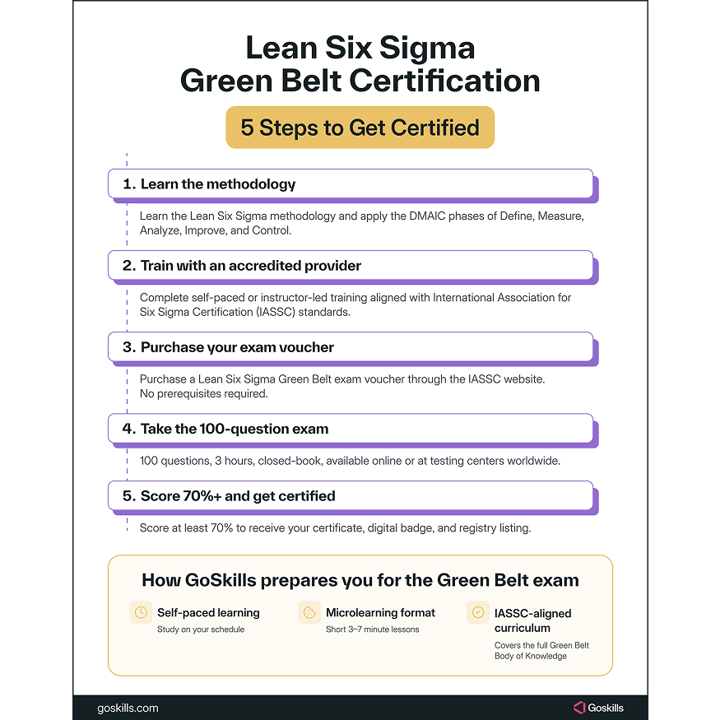
How GoSkills helps you get Lean Six Sigma certified
Transitioning into a specialized process improvement role shouldn't require you to hit "pause" on your career. GoSkills has designed a certification path that fits into the life of a busy professional.
-
Self-paced learning
We know you’re juggling deadlines. Our platform allows you to master the Green Belt body of knowledge on your own schedule. Whether you have 20 minutes during a lunch break or two hours on a Saturday, the classroom is always open.
-
Microlearning
Statistics can be daunting. We break down complex concepts — like standard deviation, regression analysis, and control charts — into digestible 3-5 minute videos. This "microlearning" approach ensures you retain information better and can apply it immediately to your daily tasks.
-
Exam prep
The ultimate goal is the certificate. The GoSkills curriculum is rigorously aligned with the standards of the International Association for Six Sigma Certification (IASSC). We provide the practice exams and the technical depth needed to walk into your test with total confidence.
Your path to efficiency starts here
The difference between a struggling department and a high-performing one is often a single person who knows how to spot waste and eliminate it. By becoming a Lean Six Sigma Green Belt, you position yourself as that person. You become the catalyst for efficiency, the guardian of quality, and a leader in your field.
Start your journey toward certification today with our Lean Six Sigma Green Belt course.