Python Functions for Data Science
Python Functions for Data Science
What you’ll learn
Skills you’ll gain
Functions are a core building block of Python and comprise an essential approach to making code more readable and reusable. In this course, you'll be introduced to common functions encountered when working with data science projects. you'll also discover various ways to use functions you may not have considered or known about. Perhaps most importantly, you'll avoid common pitfalls and mistakes when using Python functions as part of data science initiatives.
Syllabus
Download syllabus-
1
Inspect data for validation Inspecting your data is essential for data validation and debugging. 2m
-
2
Handle magnitudes and precision in data Properly handling magnitudes and controlling numeric precision is essential for interpreting data and communicating results. 2m
-
3
Aggregate data with basic functions Computing basic summary statistics is the first step in exploratory data analysis. 2m
-
4
Sort, filter, and transform your data Data in sequences often needs to be ordered or pruned before advanced analysis. 4m
-
1
Create NumPy arrays in Python NumPy arrays are the performance-optimized backbone of nearly every data science workflow in Python. 4m
-
2
Index and slice NumPy arrays Accurately accessing and extracting data from arrays is crucial for data analysis. 2m
-
3
Reshape NumPy arrays Inspecting dimensions and reorganizing arrays is vital in preparing data for computations and machine learning models. 1m
-
4
Transform and scale NumPy arrays Fast, element-wise numeric transformations are crucial for preprocessing and scaling large datasets. 2m
-
5
Extract key values with NumPy Summarizing data with key statistics is fundamental for understanding distributions and informing modeling decisions. 1m
-
6
Solve matrix-based problems with SciPy Matrix computations, like checking invertibility with determinants and finding inverses, are foundational for tasks such as solving regression systems, performing dimensionality reduction, and transforming feature spaces in data science. 2m
-
7
Run statistical functions with SciPy Working with probability distributions and hypothesis testing are essential for drawing inferences and validating models. 6m
-
1
Create pandas series and dataframes The pandas library makes tabular and time series data easy to load, explore, and manipulate. 4m
-
2
Extract data subsets from pandas objects Being able to extract the exact rows and columns you need is fundamental to data cleaning and analysis. 6m
-
3
Modify pandas objects Updating data in-place keeps your pipeline tidy and prevents errors later on. 6m
-
4
Combine data from pandas objects Combining data from multiple tables or different data sources is essential for creating robust datasets that drive deeper insights. 5m
-
5
Group data from pandas objects Aggregating data by categories helps reveal group-level patterns, which is important in exploratory data analysis. 3m
-
6
Transform data with pandas apply() Custom data transformations are essential when built-in methods fall short of specific cleaning or feature engineering needs. 5m
-
1
Create line and scatter plots Visualizing quantitative data is essential for spotting trends and relationships between numeric variables in your datasets. 3m
-
2
Display categorical distributions Visualizing categorical distributions is essential for comparing groups and understanding proportions in your data. 5m
-
3
Explore numerical distributions Understanding the shape, spread, and density of numerical data is essential for exploratory analysis. 5m
-
4
Visualize pairwise relationships Mapping pairwise relationships helps you detect correlations, clusters, and anomalies across many variables at a glance. 4m
-
5
Organize your visualizations Arranging multiple visualizations in a single figure is essential for comparing insights and crafting coherent dashboards. 5m
-
1
Apply functions to data science Congratulations on completing the course! 2m
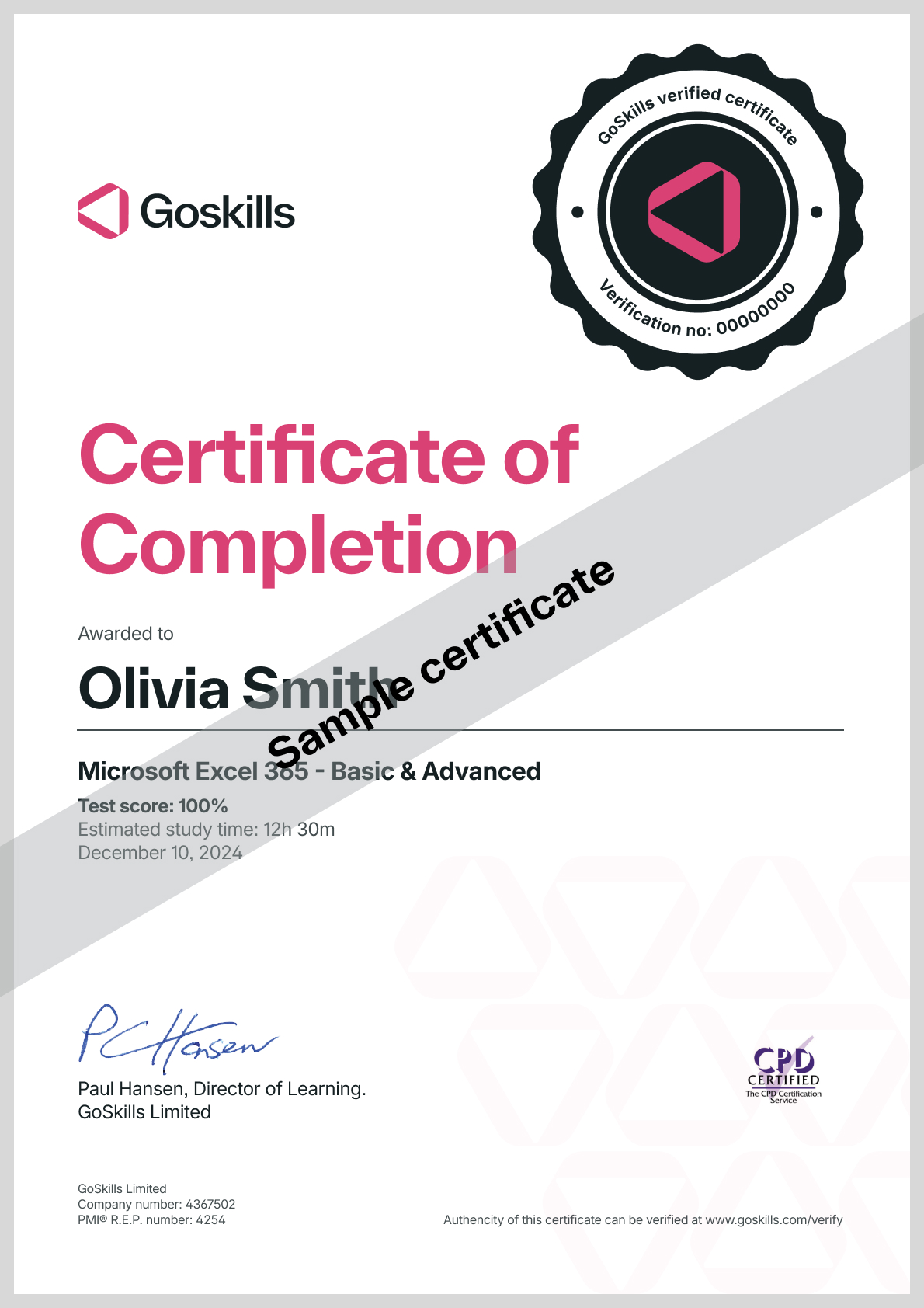
Certificate
Certificate of Completion
Awarded upon successful completion of the course.
Instructor
Lavanya Vijayan
Lavanya Vijayan is a Technical Curriculum Architect and Data Science Instructor at Madecraft. Lavanya has authored several programming and data science courses for LinkedIn Learning. She has also developed technical curriculum for Google’s Advanced Data Analytics and Cybersecurity career certifications.
Lavanya has a Master’s degree in Information and Data Science from UC Berkeley.

Lavanya Vijayan
Technical Curriculum Architect and Data Science Instructor
Accreditations
Link to awards
How GoSkills helped Chris
I got the promotion largely because of the skills I could develop, thanks to the GoSkills courses I took. I set aside at least 30 minutes daily to invest in myself and my professional growth. Seeing how much this has helped me become a more efficient employee is a big motivation.