
You’ve spent years mastering the "doing." You know the algorithms, you can write a killer email sequence, and your ROAS is the envy of the office. But now, you’re sitting across from a Director or a VP, and marketing manager interview questions aren't about that.
They aren’t asking you how to set up a campaign anymore. They are asking you how to lead a department.
This is "The Manager’s Gap" — the space between being a high-performing specialist and a strategic leader. To cross it, you have to change how you talk about your work.
What hiring managers really look for in a marketing manager
When interviewing for a role that requires leadership or management skills, the hiring team is looking for three specific "soft" shifts in your thinking:
- From tactical to strategic: Can you see the "big picture" beyond the next post?
- From execution to accountability: Do you take ownership of the budget and the bottom line?
- From individual to team: Can you multiply your results through others?
Top marketing manager interview questions (and how to answer them)
1. "How do you align marketing goals with overall business objectives?"
The trap: Answering with marketing-only metrics like "likes" or "clicks."
The strategic answer: Focus on revenue. "I start by looking at the company’s annual revenue targets. If the goal is 20% growth, I work backward to determine the required lead volume, conversion rates, and the necessary budget to hit those numbers."
2. "How do you decide which marketing channels to prioritize with a limited budget?"
The trap: Saying you'd "test everything" or choosing your favorite platform.
The strategic answer: Mention data and ROI. "I prioritize channels based on the Customer Acquisition Cost (CAC) and the Lifetime Value (LTV) of the leads they produce. I’d audit historical data to see where our 'highest-intent' traffic comes from and double down there while leaving a small percentage for experimental testing."
3. "Tell us about a time a campaign failed. How did you handle it?"
The trap: Blaming the creative team or a "bad algorithm."
The strategic answer: Focus on the pivot. "We launched a lead-gen campaign that had a high CTR but zero conversions. Instead of continuing the spend, I paused the ads, conducted a Cohort Analysis of the landing page traffic, and realized the messaging didn't match the offer. We adjusted the copy, and the conversion rate tripled within a week."
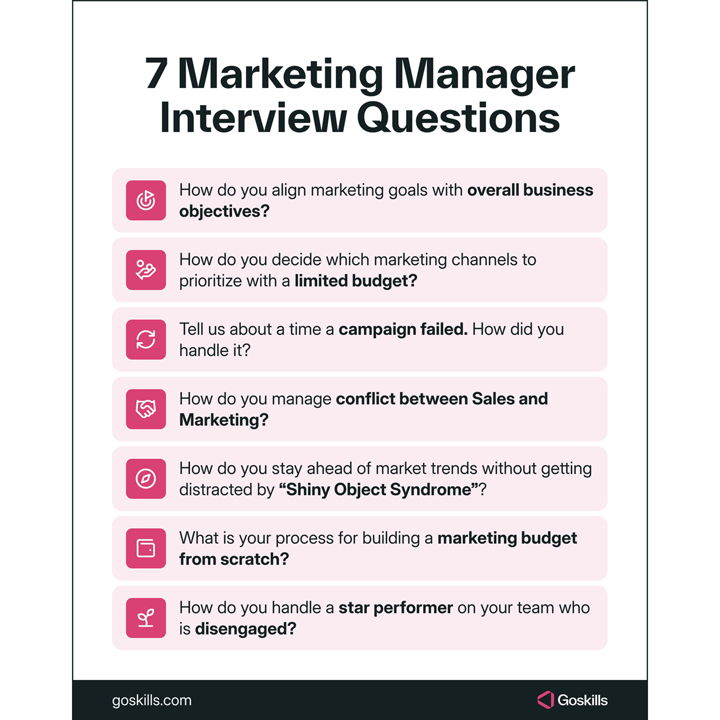
4. "How do you manage conflict between Sales and Marketing?"
The trap: Picking a side or sounding passive. For example, saying "I’d just sit everyone down to talk it out" or "I’d make sure Sales understands how hard Marketing works." This ignores the systemic nature of the problem.
The strategic answer: Focus on SLA (Service Level Agreements) and shared data. "I believe Sales-Marketing alignment is a math problem, not a personality problem. I would implement a formal lead-scoring system where both teams agree on the definition of a 'Marketing Qualified Lead' (MQL). By establishing a feedback loop where Sales provides data on lead quality and Marketing adjusts targeting in real-time, we turn a conflict into a collaborative pipeline with shared KPIs."
5. "How do you stay ahead of market trends without getting distracted by 'Shiny Object Syndrome'?"
The trap: Listing every new tool you’ve heard of (like the latest AI video generator) or, conversely, saying you ignore trends to "focus on the basics." One makes you look unfocused; the other makes you look dated.
The strategic answer: Focus on Experimental Frameworks. "I use a 70/20/10 resource allocation model. 70% of our budget and time goes to proven winners, 20% to optimizing emerging channels, and 10% to pure experimentation. This allows us to test things like AI-driven search or new social platforms in a controlled way, ensuring we innovate without risking our core revenue targets on unproven hype."
6. "What is your process for building a marketing budget from scratch?"
The trap: Asking "How much did we spend last year?" or saying you’d wait for the Finance department to give you a number. This tells the interviewer you are a "spender" of their money, not an "investor" of their capital.
The strategic answer: Focus on Reverse-Engineering Revenue Goals. "I take a bottom-up approach. If the company’s goal is $1M in new revenue and our average deal size is $10k, I know we need 100 new customers. By looking at our historical conversion rates at each stage of the funnel, I can calculate exactly how many leads and how much traffic we need to generate. I present the budget as the necessary 'input' to achieve the desired 'output.'"
7. "How do you handle a star performer on your team who is disengaged?"
The trap: Being too soft ("I'd give them a break") or too harsh ("I'd put them on a PIP immediately"). High-level management requires identifying why the output has changed before taking action.
The strategic answer: Focus on Root Cause Analysis and Coaching. "I start with a transparent 1-on-1 to identify if the roadblock is a lack of clarity, resources, or motivation. If a top performer is disengaged, it’s often because they feel their work isn’t connected to a larger purpose or they’ve hit a ceiling. I work with them to set a 30-day 'Success Plan' that aligns their personal growth—like learning a new skill in Analytics or Strategy—with the team’s current needs."
To close the "Manager's Gap", you have to change the way you talk about your work.
The 3 skills marketers lack when moving into leadership
If you want to stand out, you need to demonstrate mastery of the three skills that most "Manager" candidates lack:
1. Financial literacy (the language of the C-suite)
Leaders don’t talk about "engagement." They talk about ROI, P&L, and Budget Allocation. If you can explain how a $10,000 spend results in $50,000 of pipeline, you are already ahead of 90% of applicants.
2. People management & delegation
The biggest hurdle for new managers is "The Doer’s Reflex"—trying to do everything yourself because it’s faster. In an interview, talk about how you’ve mentored a junior staffer or how you manage freelance workflows to stay on schedule.
3. Strategic data interpretation
It’s one thing to read a Google Analytics report; it’s another to use that data to change the company’s direction. Managers must be able to spot trends in the noise and say, "The data shows our audience is shifting; we need to pivot our strategy."
Close the gap with GoSkills
Preparing for an interview is about more than just memorizing answers; it’s about having the confidence that comes from actual expertise.
Whether you need to brush up on your general leadership skills, overcome imposter syndrome, or learn the art of keeping a sales team motivated, our Leadership & Management courses are built to help you make the leap from specialist to leader.
Become a better leader
Start learning for free with Leadership & Management courses on GoSkills
Start free trial