
If you’re a working professional aiming to move from project execution into strategic leadership, a Lean Six Sigma Black Belt is one of the most powerful credentials you can earn. It signals mastery of advanced process improvement, statistical modeling, and organizational change — the skills that put you on the radar for senior operations, project management, and executive-track roles.
This guide covers exactly what a Black Belt is, how it compares to a Green Belt, which advanced tools you’ll master, and how to earn your IASSC Black Belt certification.
What is a Lean Six Sigma Black Belt?
A Lean Six Sigma Black Belt is a highly skilled professional dedicated full-time to driving organizational excellence. Unlike Green Belts, who apply Six Sigma principles as part of a broader role, Black Belts operate as internal change agents — leading enterprise-wide, cross-functional projects that directly impact business performance.
According to Ray Sheen, Lean Six Sigma Black Belt and lead instructor of the Lean Six Sigma Advanced Principles – Black Belt course on GoSkills:
A Black Belt must be able to act as both a project team leader and a coach, applying Lean Six Sigma tools and techniques without guidance from others.
— Ray Sheen, PMP, Certified Scrum Master, and IASSC Lean Six Sigma Black Belt
That level of independent mastery is what sets this certification apart from other belt certifications.
Black Belts are also mentors. They guide and develop Green Belts, building a culture of continuous improvement from within. This combination of statistical expertise and leadership responsibility is what makes the Lean Six Sigma Black Belt one of the most respected credentials in business today.
A useful way to understand the Black Belt's business value is through the Cost of Poor Quality (COPQ). COPQ represents the full cost of fixing quality problems, from internal failures like scrap, rework, and downtime, to external failures like warranties, customer complaints, and reputational damage. As Ray Sheen explains, most of these costs are hidden within business processes — like the submerged part of an iceberg — which is precisely why organizations need Black Belts who can surface and eliminate them systematically.
In practical terms, earning your Lean Six Sigma Black Belt means you can:
- Design and lead complex, high-impact improvement projects across departments
- Apply advanced statistical tools to diagnose root causes and model outcomes
- Coach and mentor Green Belts through their own project work
- Translate data-driven insights into strategic recommendations for senior leadership
How does a Black Belt differ from a Green Belt?
The move from Green Belt to Black Belt isn’t just about learning more tools — it’s a shift in scope, depth, and organizational impact.
| Feature | Green Belt | Black Belt |
|---|---|---|
| Project scope | Local/Departmental | Enterprise-wide/Cross-functional |
| Statistical depth | Basic descriptive statistics | Advanced inferential statistics and modeling |
| Time commitment | Part-time (25% of role) | Full-time (100% of role) |
| Key responsibility | Project execution | Strategy, mentoring, and leadership |
To put it plainly: a Green Belt fixes a process; a Black Belt transforms an entire system. Whereas a Green Belt might reduce defects on a single production line, a Black Belt redesigns the workflow across multiple teams, identifies systemic root causes, and builds the infrastructure to sustain improvements over the long term. If you hold a Six Sigma Green Belt and want to move into a leadership-oriented role, the Black Belt program is your natural next step.
What advanced DMAIC skills does a Black Belt master?
Black Belts don’t just follow the DMAIC (Define, Measure, Analyze, Improve, and Control) methodology; they master the advanced statistical toolkit behind it. The IASSC Black Belt Body of Knowledge covers all five phases of DMAIC in depth, and proficiency across every phase is required to earn certification. Here’s where the real depth lives:
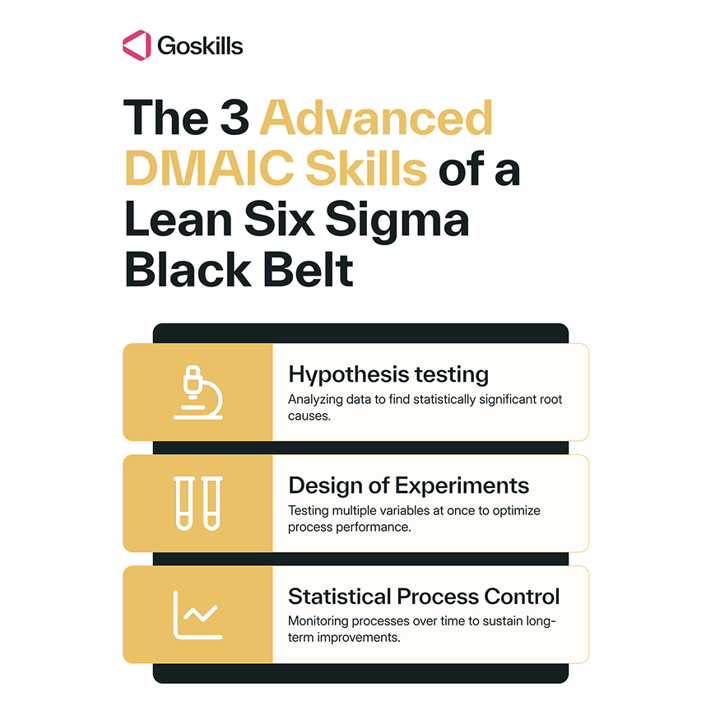
1. Analyze phase: hypothesis testing and inferential statistics
At the Green Belt level, analysis often involves descriptive statistics and basic root cause tools. At the Black Belt level, you move into inferential statistics — using hypothesis testing (including t-tests, ANOVA, Mann-Whitney, and Chi-Squared tests) to determine whether observed differences are statistically significant, and regression analysis to model relationships between variables and predict future outcomes.
2. Improve phase: design of experiments (DOE)
Design of Experiments is one of the most powerful tools in the Black Belt’s arsenal, typically applied when a solution requires a common cause process change, where the root cause isn’t obvious and the relationships between factors are complex. Rather than changing one variable at a time, DOE uses controlled tests of multiple factor combinations to build a mathematical model of system performance, allowing you to identify which factors must be controlled, and at what levels, to consistently hit performance targets. According to Ray Sheen, DOE is applicable on approximately 25% of Lean Six Sigma projects, reserved for situations where other, faster analysis methods aren’t sufficient to determine what needs to change.
3. Control phase: statistical process control (SPC)
Improvement without sustainability is just a temporary fix. Black Belts implement Statistical Process Control using tools such as I-MR charts, Xbar-R charts, and EWMA charts to monitor processes over time, detect variation early, and prevent regression. SPC transforms a one-time win into a permanent operational standard.
Mastering the DMAIC methodology at this level is what separates a certified Black Belt from someone who simply knows Six Sigma methodologies in theory. That means proficiency across all five phases, with the full statistical depth the IASSC Body of Knowledge demands.
What leadership skills does a Black Belt need?
Data alone doesn’t change organizations — people do. A Black Belt’s effectiveness depends as much on leadership capability as on statistical fluency. As Ray Sheen puts it:
The IASSC Black Belt Body of Knowledge is focused on the technical tools and techniques of Lean Six Sigma. To be an effective Black Belt in most organizations, the individual must also have or develop team leadership skills and project management skills.
— Ray Sheen, PMP, Certified Scrum Master, and IASSC Lean Six Sigma Black Belt
Two leadership development training areas stand out:
- Stakeholder management
- Change leadership
Stakeholder management
Black Belts work across departments, which means navigating competing priorities, building buy-in, and communicating complex data in ways that resonate with non-technical audiences. As Ray Sheen explains in the GoSkills Black Belt course, stakeholders’ focus is always on the part of the business they're responsible for — not the Lean Six Sigma methodology. That means a Black Belt must coach without jargon, anchor every conversation in business impact, and guide stakeholders through decisions driven by data rather than by seniority or politics. In practice, this involves managing two common challenges: the action-oriented stakeholder who jumps to conclusions before the data is ready, and the indecisive stakeholder who falls into analysis paralysis and keeps requesting more information before acting.
Change leadership
Implementing process improvement at scale means managing resistance, sustaining momentum, and helping teams adopt new ways of working. Part of that leadership responsibility is quantifying the value of change in financial terms, using tools like payback period analysis for smaller projects or Net Present Value (NPV) for larger capital investments, so that operational managers can budget and plan with confidence. A Black Belt who can connect process data to financial outcomes and who understands the essential soft skills behind lasting change will be far more effective at driving lasting organizational change than one who relies on data alone.
These interpersonal and financial capabilities are what allow Black Belts to lead — not just deliver.
How do you earn a Lean Six Sigma Black Belt certification?
A Lean Six Sigma Black Belt certification validates that you have mastered the full IASSC Body of Knowledge across all five DMAIC phases. Here is what the process looks like.
The IASSC certification body
The GoSkills Black Belt program is aligned with the International Association for Six Sigma Certification (IASSC) — an independent, globally recognized certifying body that does not sell training or coaching. IASSC establishes the Body of Knowledge based on input from industry experts and provides certification testing for proficiency in that body of knowledge. This independence is what gives IASSC belt certifications their credibility with employers worldwide.
The Black Belt exam: what to expect
The IASSC Black Belt certification exam is a four-hour, closed-book, proctored exam containing 150 multiple-choice and true/false questions. It covers all five DMAIC phases in depth.
Watch Ray Sheen walk through the complete IASSC Black Belt Body of Knowledge in the video below:
Key exam details to know:
- The passing threshold is approximately 77%.
- Some questions carry partial credit, and some are weighted more heavily than others — meaning your effective pass score may vary slightly.
- No calculators or personal notes are permitted; however, IASSC provides a summary of key statistical tables and equations during the exam.
- Exams are administered through PearsonVue testing centers, with over 8,000 locations across 165 countries, as well as remote proctoring options.
There are no formal prerequisites to register — when you have mastered the material, you can go to the IASSC website and register. For current exam fees, check the IASSC website directly, as pricing may vary by region and is subject to change.
For context, the IASSC also offers a Green Belt exam (100 questions, 3 hours) and a Yellow Belt exam (60 questions, 2 hours) — so the Black Belt exam is the most comprehensive of the three available belt certifications.
Why study your Black Belt with GoSkills?
The Lean Six Sigma Advanced Principles – Black Belt course on GoSkills is built for busy professionals who need a flexible, rigorous path to certification. It covers the complete IASSC Black Belt Body of Knowledge across 87 lessons, delivered by Ray Sheen — a practicing Lean Six Sigma Black Belt with real-world industry experience.
- Micro-learning for your workday. Lessons are structured as 3–5 minute modules, breaking complex statistical concepts — from DOE and regression analysis to SPC control charts — into manageable wins you can fit into a packed schedule.
- Mobile-friendly and always accessible. Learn on any device, at your own pace — whether you're commuting, traveling, or carving out time between meetings.
- IASSC-aligned curriculum. The course is designed to prepare you for the IASSC Black Belt certification exam, so the credential you earn carries real weight with employers worldwide.
- Expert-led instruction. Ray Sheen brings real-world Black Belt experience into every lesson, connecting statistical theory to the practical challenges you'll face leading projects in the field.
Because Black Belts are also mentors, complementing your technical Lean Six Sigma training with leadership and management courses is a smart investment — it rounds out your toolkit and prepares you to develop the Green Belts on your team.
Ready to make the leap? Start your free trial and take the first step toward Black Belt mastery today.
Frequently asked questions (FAQs) about the Lean Six Sigma Black Belt
What is the IASSC Black Belt Body of Knowledge?
The IASSC Black Belt Body of Knowledge is the official list of topics and tools that a Lean Six Sigma Black Belt practitioner must know. It covers all five DMAIC phases — Define, Measure, Analyze, Improve, and Control — and is targeted at professionals who lead Lean Six Sigma projects and coach others. It is the definitive study guide for anyone preparing for the IASSC Black Belt certification exam.
How many questions are on the IASSC Black Belt exam?
The IASSC Black Belt certification exam consists of 150 multiple-choice and true/false questions and must be completed within four hours. Candidates must achieve a minimum score of 70% to pass. The exam is closed-book and proctored, with no personal notes or calculators permitted, though some questions may be weighted and allow partial credit.
Do you need a Green Belt before earning a Black Belt?
There are no formal prerequisites set by IASSC to sit for the Black Belt exam — you can register as soon as you feel prepared. That said, the Black Belt Body of Knowledge builds significantly on Green Belt-level concepts. Most professionals pursuing Black Belt certification either hold a Six Sigma Green Belt or have equivalent practical experience with DMAIC and basic statistical tools.
What is the difference between an IASSC Black Belt and a company-issued certification?
IASSC is an independent certifying body that does not sell training — it only tests and certifies. This makes IASSC Black Belt certification universally portable and employer-recognized, unlike company-internal belt certifications, which are valid within that organization but may not be recognized elsewhere. For professionals seeking a credential that travels with their career, an accredited certification from an independent body like IASSC is the stronger choice.
Start Your Lean Six Sigma journey with GoSkills
Whether you're just getting started or ready to advance to the highest level, GoSkills offers a complete Lean Six Sigma course collection to take you there.
Start your 7-day free trial and take the next step in your Lean Six Sigma journey.