Introduction to Bookkeeping for Small Business Owners
Introduction to Bookkeeping for Small Business Owners
What you’ll learn
Skills you’ll gain
When starting a business, you may not know what is required to account for your financial transactions. Do you need to register for a sales tax permit? Understand how to process 1099s? Do those terms mean anything to you? It can be an overwhelming task to set up your bookkeeping file if you are unsure of the terms, and what the process is to record your company’s activity. In this course, Profitability and Growth advisor Candy Messer, will explain definitions for terms commonly used in accounting as well as how to post different types of transactions. She will also review guidelines regarding 1099 reporting and sales tax compliance. After completing this course, you’ll understand how to set up your bookkeeping file, and how to enter your business activity accurately. You’ll also hear tips on how to organize your documentation for tax preparation and making required estimated tax payments. You’ll have peace of mind knowing you’ll be complying with the law and confident producing accurate financial statements.
Syllabus
Download syllabus-
1
Chart of accounts Proper account set-up is imperative for accurate books. 3m
-
2
Defining reconciling Reconciling is necessary to verify all transactions have been posted. 2m
-
3
Understanding income statements Monitoring profit is important to identify the health of your business. 3m
-
4
Optimizing balance sheets Making sure you own more than you owe helps guarantee success. 3m
-
5
General ledgers Seeing how money was earned and spent allows needed corrections. 3m
-
6
Monitoring cash flow Predict funds available by monitoring cash flow. After this lesson, you'll be able to recognize how money flows into and out of the business. 3m
-
7
Revenue versus profit Recognizing the difference between revenue and profit is imperative to your success. 3m
-
8
Liabilities and expenses Proper posting of liabilities is imperative to knowing what you owe. 3m
-
1
Business versus personal funds Personal accounts used for business is a red flag and not allowed for entities. 3m
-
2
Tracking business transactions Accounting systems allow for easy reporting and tax preparation. 3m
-
3
Setting up loans/assets Proper tracking of liabilities is imperative. 3m
-
4
Recording transfers Track money movement between assets, liabilities, and equity accounts. 2m
-
5
Depreciation and amortization Depreciation and Amortization affect tax filings and profitability. 4m
-
6
Using journal entries Certain business activities can't be posted with other transaction types. 4m
-
7
Cash and accrual reporting The accounting method affects profit and tax due. 3m
-
8
Customer prepayments Funds to be earned over time are documented as liabilities. 3m
-
9
Defining class tracking Examining areas of your business assists with decision-making. 2m
-
10
Defining job costing Job costing allows you to identify where changes may be needed. After this lesson, you'll be able to monitor income/expenses by customer. 3m
-
11
Monitoring bartering services Bartering is considered taxable activity and sales/expenses must be monitored. 3m
-
1
Contractors versus employees Failing to properly employ workers can result in penalties. After this lesson, you'll be able to classify those who provide you services correctly. 2m
-
2
Mapping 1099 accounts Properly mapping accounts allows you to identify who must be issued a 1099. 3m
-
3
W9/1099 Forms Penalties apply when payments aren't properly reported. 2m
-
4
Issuing a 1099 Certain payments aren't reportable and doing so could cause issues. 4m
-
5
1099 due dates Late filings result in penalties. 2m
-
6
Correcting 1099 mistakes Correcting errors is needed so vendors are tax appropriately. After this lesson, you'll be able to adjust errors on forms filed incorrectly. 4m
-
1
Organizing documents Documentation to prove expenses for tax prep and audits is necessary. 3m
-
2
Estimated tax payments Estimated tax payments must be paid timely to avoid penalties. 4m
-
3
Tax preparation reports Accurate records are necessary for tax filings and payment calculations. 2m
-
1
Maintaining compliance Thank you for watching this course! 1m
Certificate
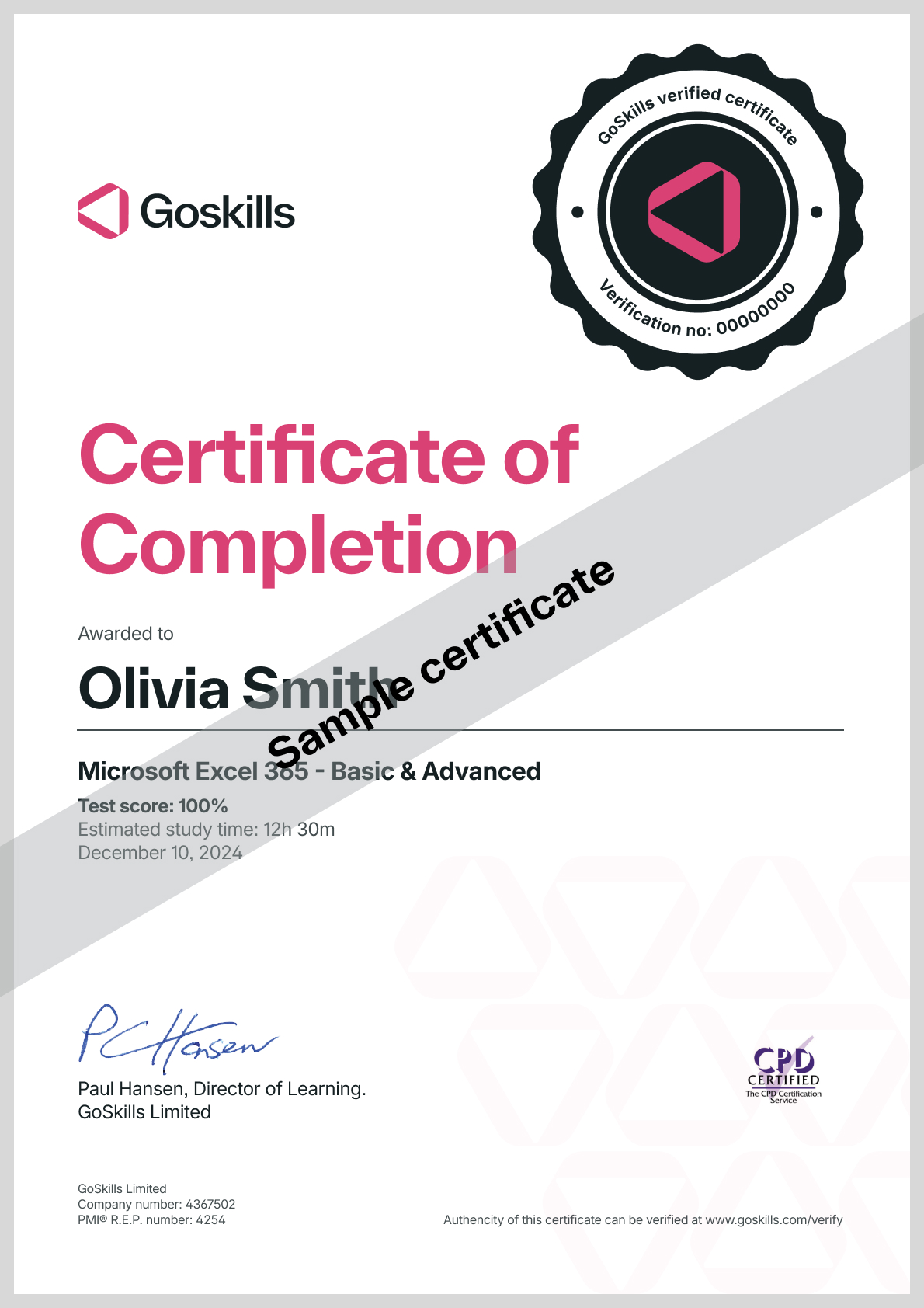
Certificate of Completion
Awarded upon successful completion of the course.
Instructor
Candy Messer
Candy Messer is a profitability advisor working with entrepreneurs to produce successful businesses. Experienced in bookkeeping since 1998, Candy understands the stresses business owners face, and offers customized services to meet their varying needs. She is a co-author of “Business Success with Ease and Navigating Entrepreneurship,” and is the host of the “Biz Help For You” podcast which can be found on YouTube as well as multiple podcast channels. When not running her company, Candy enjoys reading, crocheting, logic puzzles and spending time with friends and family.

Candy Messer
Bookkeeping and Payroll Expert, Author, Speaker
Accreditations
Link to awards
How GoSkills helped Chris
I got the promotion largely because of the skills I could develop, thanks to the GoSkills courses I took. I set aside at least 30 minutes daily to invest in myself and my professional growth. Seeing how much this has helped me become a more efficient employee is a big motivation.