Coaching Agile Teams: How to Improve Agile Team Performance
Coaching Agile Teams: How to Improve Agile Team Performance
What you’ll learn
Skills you’ll gain
Agile is becoming more and more common in our world today. However, that does not mean that everyone views it equally. In this course, Dylan Jensen will share insights on how to help your organization find a unified Agile front by giving you skills to increase unity and teamwork. Dylan starts by explaining how to handle change in its infancy, and then moves on to explain how to create team and organizational unity. He will also explain the ever-important principle and concept of creating value streams in your organization and how to make that happen. Finally, Dylan will discuss the importance of building a positive influence around Agile from the bottom of your organization first and then moving to the top.
Syllabus
Download syllabus-
1
Practice clear communication Change makes everyone nervous. 3m
-
2
Communicate the value proposition People don't want to work just to work. 3m
-
1
Optimize your meetings Sometimes agile gets a bad rap for having too many meetings. 3m
-
2
Build a working agreement Building a strong team requires setting appropriate boundaries. 3m
-
3
Leverage change champions Change is hard for some and easy for others. After this lesson, you'll be able to effectively discover and utilize change champions. 2m
-
4
Commit to unification Changing the way you and your team's work can be a serious challenge. 3m
-
5
Map and solve dysfunctions Dysfunction exists in every team. 3m
-
1
Facilitate cross-team meetings Making sure everyone is aware of each other's challenges and dependencies is critical. 2m
-
2
Demonstrate value with metrics It is very easy to utilize agile metrics in an ineffective manner which does not engage business leaders. 3m
-
3
Focus on business needs Everything an Agile team does focuses on furthering the success of the organization. 2m
-
4
Involve leadership A critical component of making Agile work within a company is ensuring all levels of the organization are on the same page. 2m
-
5
Engage appropriate stakeholders While Agile teams thrive with self-organization, they must ensure the right people know what they are working on. 2m
-
1
Identify the high level process The work you do often has dependencies slowing you down. 2m
-
2
Map the process Mapping out the process gives you clarity on what delivering a product involves. 3m
-
3
Calculate process efficiency Do you know where your team's largest inefficiencies are? 3m
-
4
Create cross-functional value streams Value streams allow your teams to improve their cross-functional work and refocus on delivering valuable products. 3m
-
1
Start from the bottom Thank you for watching this course! 1m
Certificate
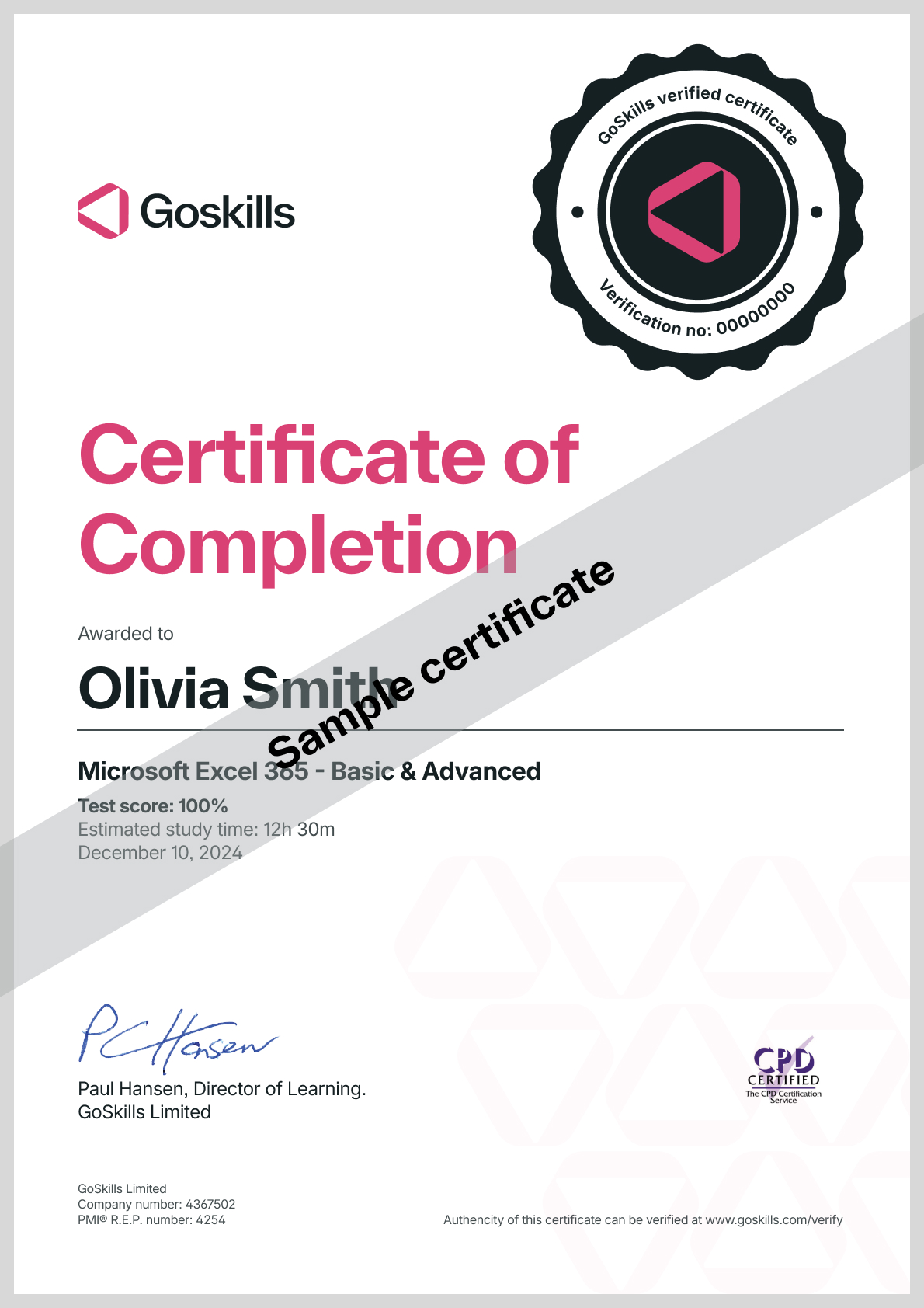
Certificate of Completion
Awarded upon successful completion of the course.
Instructor
Dylan Jensen
Dylan has worked as a consultant and coach for multiple Fortune 500 companies. His experience with agile implementation has equipped him with the skills and perspective to transform how organizations grow and succeed. Dylan believes that all agile transformations begin with building the right teams and fostering the right organizational mindset. He is certified as an Agile Coach, a SAFe 5 Agilist, and a Scrum Master, and holds both a Master of Business Administration and a Master’s in Human Resources from Utah State University.

Dylan Jensen
Certified Agile Coach and SCRUM Master
Accreditations
Link to awards
How GoSkills helped Chris
I got the promotion largely because of the skills I could develop, thanks to the GoSkills courses I took. I set aside at least 30 minutes daily to invest in myself and my professional growth. Seeing how much this has helped me become a more efficient employee is a big motivation.