Creating a Business of Your Own
Creating a Business of Your Own
What you’ll learn
Skills you’ll gain
There’s never been a better time to start a business. For many, having a business of your own means breaking free from the 9-to-5 and building a lasting income stream that enables you to live life more of your own choosing. In this course, entrepreneurship expert Navjot Brar shares all the essential steps to starting a business yourself. This includes how to come up with your own ideas, as well as the vetting process to analyze them. You'll learn how to find the right product-market fit for yourself, along with how to think about revenue and pricing. You'll also discover how to structure your company and create a minimum viable product (MVP), which can save you significant time and money. By the end of the course you'll be equipped with the skills and tools to start a business of your own.
Syllabus
Download syllabus-
1
Start with a problem Problems are an important part in coming up with business ideas as these often give insight into an unfulfilled need. 2m
-
2
Workshopping ideation If you're having trouble coming up with problems or business ideas, it's important to brainstorm. 2m
-
3
Execution is worth millions Business plans, more often than not, don't survive their first contact with customers. 4m
-
1
Product-market fit Product-market fit is the degree to which a product satisfies a strong market demand. 3m
-
2
Solution building The solution is how your business will solve the problem it is advertising to overcome. 4m
-
3
Market size Understanding your market size is necessary for growing your business and getting funding. 3m
-
4
Revenue model In order to sustain a successful business, you need to obtain money. 4m
-
5
Pricing models If you're introducing a market to a product they have never seen before, you will need to determine how to price your product. 5m
-
6
Go-to-market strategy Once your product has been created, you will need to determine how to launch your product in order to obtain a greater volume of users and customers. 4m
-
1
Creating an MVP A minimum viable product (MVP) is a version of a product with just enough features to be usable. 4m
-
2
Interviewing users Interviewing users can be a great resource for qualitative data directly from the individuals who have the pain point that you plan to solve. 4m
-
3
A/B testing One method of evaluating your product-market fit is to utilize A/B testing. 4m
-
4
Pivot or persevere? Eventually, your product and idea will reach a point where it's time to move forward, make a change, or scrap the idea. 3m
-
1
Identifying cofounding skills Every business model will need a different subset of necessary cofounding skills. 4m
-
2
Recruiting cofounders Starting a business is hard enough, and doing so alone can feel impossible. 3m
-
3
Startup equity Every set of cofounders eventually has the discussion as to how they want to split up compensation and equity among the team. 3m
-
4
Creating a new culture Making sure your team has a common set of values and a core mission can create greater alignment. 2m
-
1
Parting advice 1m
Certificate
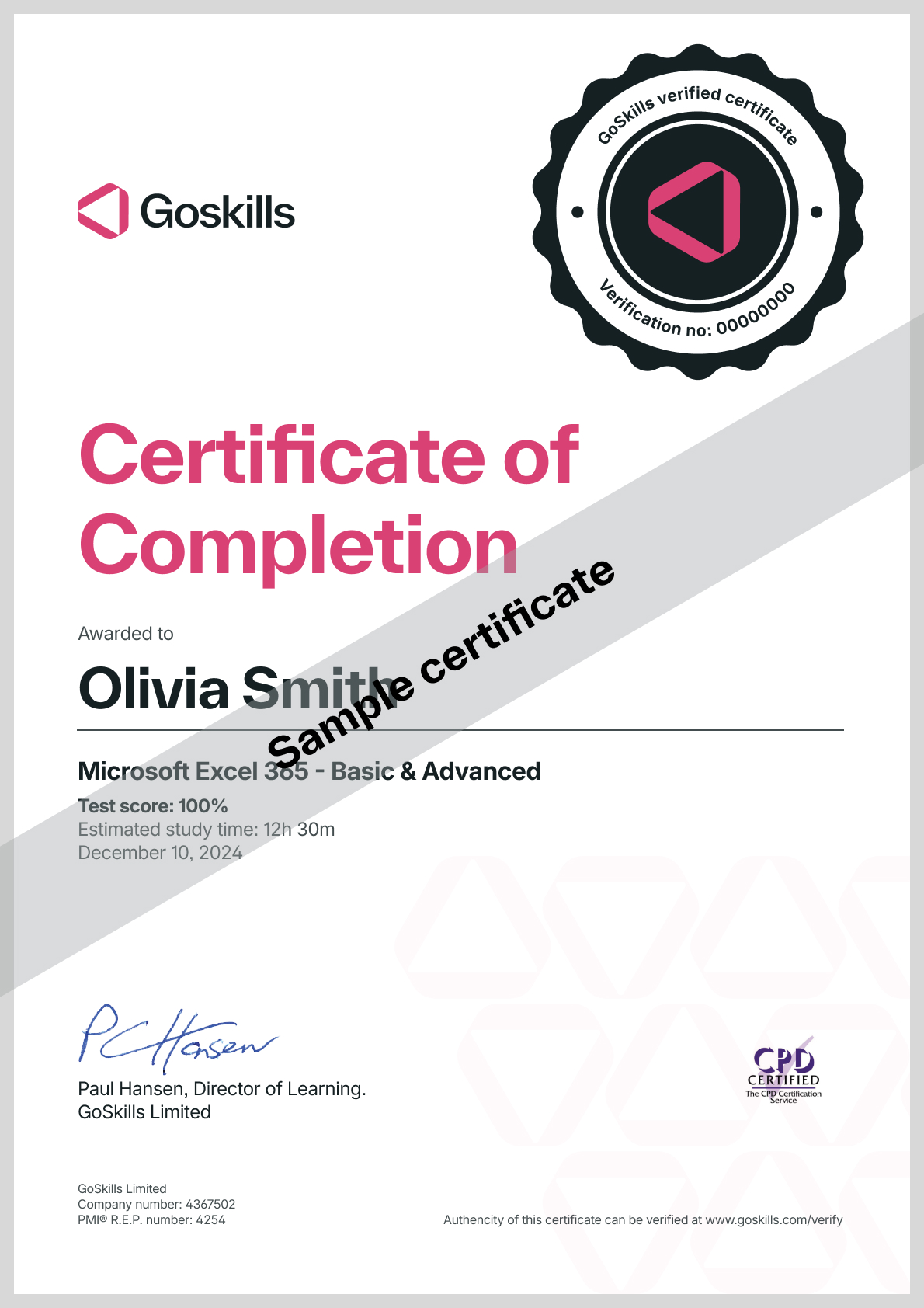
Certificate of Completion
Awarded upon successful completion of the course.
Instructor
Navjot Brar
Navjot Brar is a startup enthusiast, product manager, and entrepreneur who is passionate about new product development and startup communities. Navjot specializes in technology products related to big data and artificial intelligence.

Navjot Brar
Product Manager and Startup Evangelist
Accreditations
Link to awards
How GoSkills helped Chris
I got the promotion largely because of the skills I could develop, thanks to the GoSkills courses I took. I set aside at least 30 minutes daily to invest in myself and my professional growth. Seeing how much this has helped me become a more efficient employee is a big motivation.