Introduction to Data Science
Introduction to Data Science
What you’ll learn
Skills you’ll gain
Data Science is shaping the business world like never before, and demand for data scientists has never been higher. In this course, data scientist and Python trainer Lavanya Vijayan shares the fundamentals of Data Science and what sets it apart from other information-driven techniques. Lavanya then breaks down the components of Data Science, covering workflow and toolsets such as programming languages and specialized resources like Jupyter Notebooks. Lavanya centers on techniques like exploratory data analysis, data cleaning, and data visualization. She also explores the topics of sampling, testing, and classification. Through this course you'll be prepared to execute basic data analysis and reporting, opening up the opportunities to further your career in this increasingly relevant field.
Syllabus
Download syllabus-
1
Demystifying data science Data Science is rapidly increasing in popularity and demand, and is a valuable skill as both a career or skill within an existing role. 3m
-
2
The value of data science Data Science can be used across numerous fields and offers important benefits to the world around you. 1m
-
3
Defining the data science life cycle Data scientists follow a specific workflow. 1m
-
1
Reducing bias with probability sampling Data design, the process of data collection, is important in data science. 4m
-
2
Using non-probability sampling You can also collect data with non-probability sampling techniques. 2m
-
1
Comparing Python and R Two of the most popular computing languages for data science are currently Python and R. 2m
-
2
Setting up your Jupyter environment You'll want to set up your data science projects to be successful, and using Jupyter notebook is a great way to do so. 3m
-
1
Defining tabular data Datasets can be structured in many ways, but they're easiest to work with when structured in a table. 2m
-
2
Reading tabular data Once you have access to a dataset, you will need to interact with it and read the data most quickly and efficiently. 6m
-
3
Interpreting tabular data Being able to read data effectively is only half the battle - you also want to be able to analyze the data for insights. 2m
-
4
Gathering insights Tabular data manipulation and drawing conclusions from data is a crucial component of data science. 5m
-
5
Answering specific questions The goal of data science is to identify and answer specific questions. 2m
-
1
Defining exploratory data analysis Conducting exploratory data analysis (EDA) is the next crucial stage in the data science life cycle. 1m
-
2
Recognizing statistical data types Statistical data types, including numerical and categorical data, are at the core of most data science operations. 3m
-
3
Distinguishing properties of data EDA involves determining the key properties of the data you have. 5m
-
1
Explaining data cleaning Data cleaning is a crucial stage in the data science life cycle because it ensures you're working with data that is accurate and organized. 1m
-
2
Questions to guide data cleaning Before you dive in and start cleaning your data, you'll want to gain some baseline information to help you navigate this process. 4m
-
1
Demystifying data visualization Once you determine the granularity, scope, temporality, and faithfulness of your data, you'll want to connect the relationships among your data. 1m
-
2
Visualizing your qualitative data Different types of visualization correspond to different types of data. 5m
-
3
Visualizing your quantitative data Different types of visualization correspond to different types of data. 8m
-
1
Defining inference Inference is also an integral part of the last stage in the data science life cycle - this is when you put the question you want answered to the test. 1m
-
2
Designing a hypothesis test Hypothesis testing is a helpful method you can use to identify if the results you're seeing in the data are meaningful. 5m
-
3
Creating a permutation Hypothesis testing allows data scientists to make informed conclusions based on the data that they observe. 4m
-
4
Conducting a permutation test If you have two or more samples of data, you'll find that using a permutation test will be helpful for you to prove your hypothesis. 6m
-
5
Bootstrapping a confidence interval You can use a confidence interval to test your hypothesis, or estimate. 7m
-
1
Defining prediction for data science When you make a prediction about your dataset, you can test against it. 1m
-
2
Navigating classification Classification is an important machine learning technique you can use when working with data. 2m
-
3
Recognizing the k-NN algorithm k-NN or k-Nearest Neighbor is a common Data Science algorithm. 3m
-
4
Implementing k-Nearest Neighbors k-Nearest Neighbors is a great algorithm to use, but navigating it with an example can be helpful to fully grasp the concept. 7m
-
5
Navigating regression Regression is all about exploring relationships, which is often what evaluating data involves. 2m
-
6
Checking assumptions of regression You can use linear regression to help you predict the value of one variable using the value of another. 2m
-
7
Implementing linear regression Linear regression uses a dependent and independent variable to help you test and form the relationships within your data. 6m
-
1
Next Steps Thanks for watching this course! 1m
Certificate
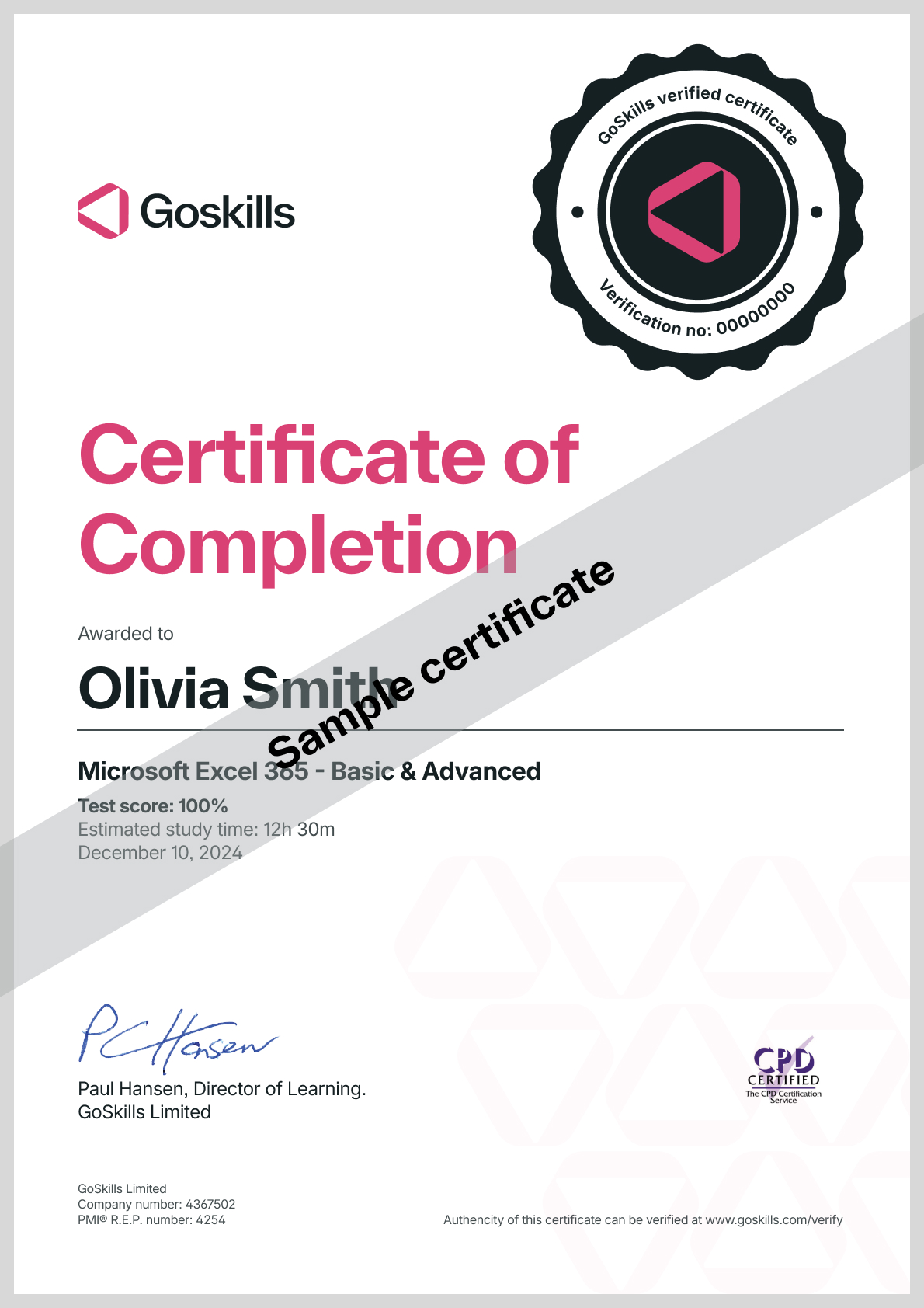
Certificate of Completion
Awarded upon successful completion of the course.
Instructor
Lavanya Vijayan
Lavanya Vijayan is a Technical Curriculum Architect and Data Science Instructor at Madecraft. Lavanya has authored several programming and data science courses for LinkedIn Learning. She has also developed technical curriculum for Google’s Advanced Data Analytics and Cybersecurity career certifications.
Lavanya has a Master’s degree in Information and Data Science from UC Berkeley.

Lavanya Vijayan
Technical Curriculum Architect and Data Science Instructor
Accreditations
Link to awards
How GoSkills helped Chris
I got the promotion largely because of the skills I could develop, thanks to the GoSkills courses I took. I set aside at least 30 minutes daily to invest in myself and my professional growth. Seeing how much this has helped me become a more efficient employee is a big motivation.